







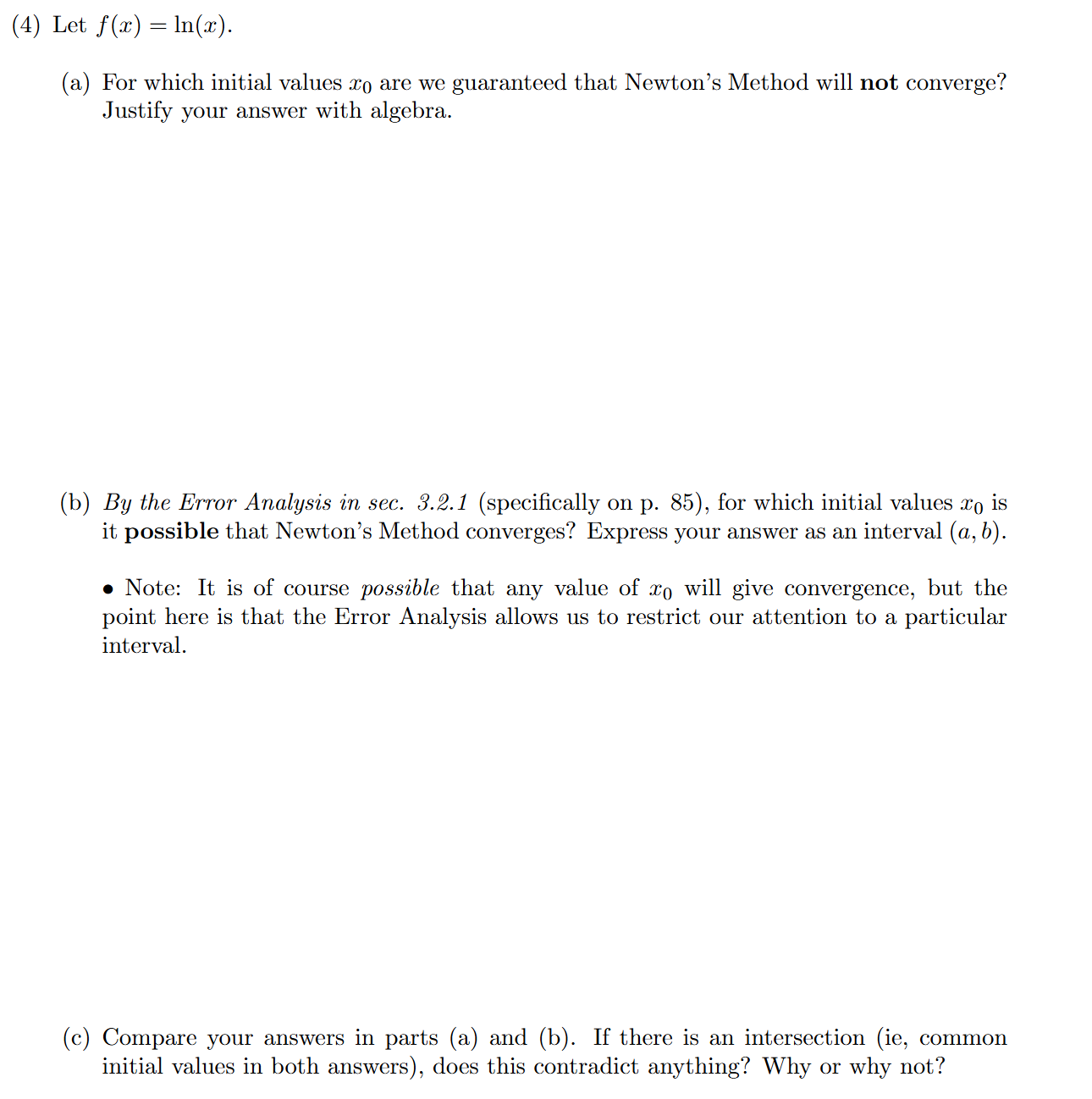
Question: ( 4 ) Let ( f ( x ) = ln ( x ) ) . ( a ) For which initial
Let fxln x
a For which initial values x are we guaranteed that Newton's Method will not converge? Justify your answer with algebra.
b By the Error Analysis in secspecifically on p for which initial values x is it possible that Newton's Method converges? Express your answer as an interval a b
Note: It is of course possible that any value of x will give convergence, but the point here is that the Error Analysis allows us to restrict our attention to a particular interval.
c Compare your answers in parts a and b If there is an intersection ie common initial values in both answers does this contradict anything? Why or why not?
Step by Step Solution
There are 3 Steps involved in it
1 Expert Approved Answer
Step: 1 Unlock

Question Has Been Solved by an Expert!
Get step-by-step solutions from verified subject matter experts
Step: 2 Unlock
Step: 3 Unlock
 Study Help