





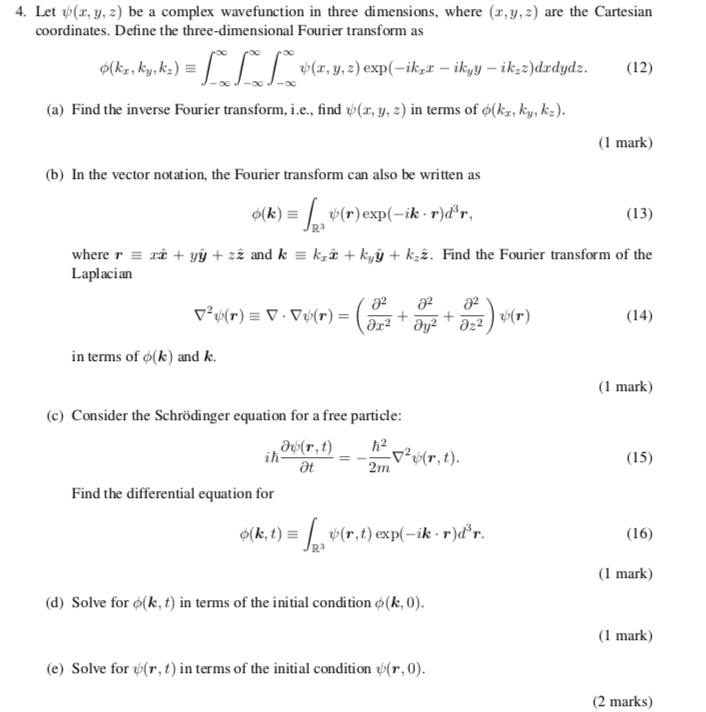
Question: 4. Let (r, y, z) be a complex wavefunction in three dimensions, where (r,y, 2) are the Cartesian coordinates. Define the three-dimensional Fourier transform as
4. Let (r, y, z) be a complex wavefunction in
4. Let (r, y, z) be a complex wavefunction in three dimensions, where (r,y, 2) are the Cartesian coordinates. Define the three-dimensional Fourier transform as o(ks, ky, k=) = (x, y.=) exp(-iksa - ikyy - ik,z)didydz. (12) (a) Find the inverse Fourier transform, i.e., find to(r, y, 2) in terms of o(kx, ky, k=). (1 mark) (b) In the vector notation, the Fourier transform can also be written as (k) = (r)exp (-ik . r)dr, (13) where r = ci + yy + 22 and k = kra + kyy + k,2. Find the Fourier transform of the Laplacian V'd(r) = V . Vu(r) = 02 + Or2 a2 2 $5(r) (14) in terms of o(k ) and k. (1 mark) (c) Consider the Schrodinger equation for a free particle: ih- Orb(r, t) h2 at V'i ( r , t ) . 2m (15) Find the differential equation for o ( k, t ) = (r,t) exp(-ik . r)d'r. (16) (1 mark) (d) Solve for o(k, t) in terms of the initial condition o(k, 0). (1 mark) (e) Solve for th(r, t) in terms of the initial condition th(r, 0). (2 marks)

Step by Step Solution

There are 3 Steps involved in it

1 Expert Approved Answer
Step: 1 Unlock blur-text-image

Question Has Been Solved by an Expert!

Get step-by-step solutions from verified subject matter experts

Step: 2 Unlock
Step: 3 Unlock

Students Have Also Explored These Related Mathematics Questions!