







Question: 4 misstatement For each term in the first column below, identify its definition (or partial definition). Each definition may be used once or not at
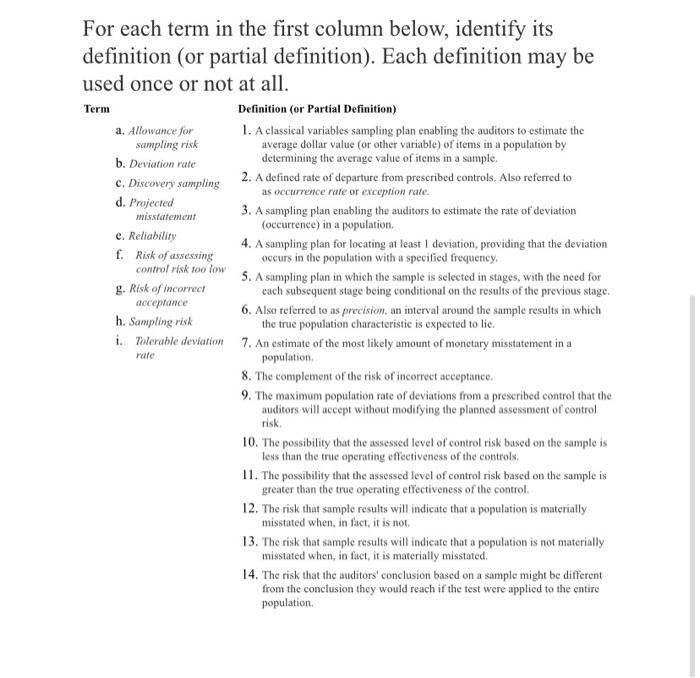
misstatement For each term in the first column below, identify its definition (or partial definition). Each definition may be used once or not at all. Term Definition (or Partial Definition) a. Allowance for 1. A classical variables sampling plan enabling the auditors to estimate the sampling risk average dollar value (or other variable) of items in a population by b. Deviation rate determining the average value of items in a sample. c. Discovery sampling 2. A defined rate of departure from prescribed controls. Also referred to as occurrence rate or exception rate. d. Projected 3. A sampling plan enabling the auditors to estimate the rate of deviation (occurrence) in a population e. Reliability 4. A sampling plan for locating at least I deviation, providing that the deviation f. Risk of assessing occurs in the population with a specified frequency control risk too low 5. A sampling plan in which the sample is selected in stages, with the need for g. Risk of incorrect cach subsequent stage being conditional on the results of the previous stage. acceptance 6. Also referred to as precision, an interval around the sample results in which h. Sampling risk the true population characteristic is expected to lie. i. Tolerable deviation 7. An estimate of the most likely amount of monetary misstatement in a population 8. The complement of the risk of incorrect acceptance. 9. The maximum population rate of deviations from a prescribed control that the auditors will accept without modifying the planned assessment of control risk 10. The possibility that the assessed level of control risk based on the sample is less than the true operating effectiveness of the controls 11. The possibility that the assessed level of control risk based on the sample is greater than the true operating effectiveness of the control 12. The risk that sample results will indicate that a population is materially misstated when, in fact, it is not 13. The risk that sample results will indicate that a population is not materially misstated when, in fact, it is materially misstated. 14. The risk that the auditors' conclusion based on a sample might be different from the conclusion they would reach if the test were applied to the entire population rale
Step by Step Solution
There are 3 Steps involved in it

Get step-by-step solutions from verified subject matter experts
 Study Help