







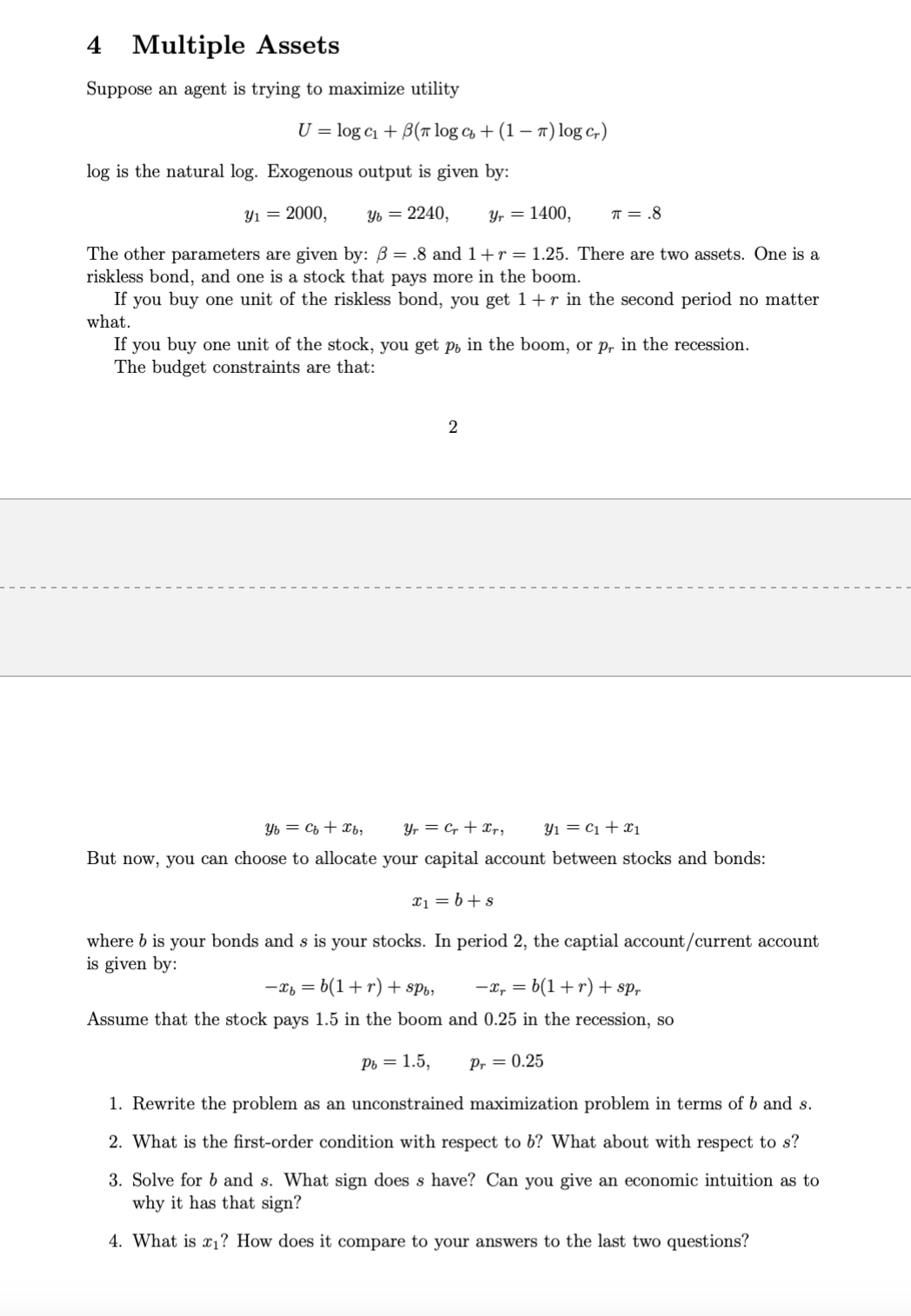
Question: 4 Multiple Assets Suppose an agent is trying to maximize utility U = l o g c 1 + ( l o g c b
Multiple Assets
Suppose an agent is trying to maximize utility
is the natural log Exogenous output is given by:
The other parameters are given by: and There are two assets. One is a
riskless bond, and one is a stock that pays more in the boom.
If you buy one unit of the riskless bond, you get in the second period no matter
what.
If you buy one unit of the stock, you get in the boom, or in the recession.
The budget constraints are that:
But now, you can choose to allocate your capital account between stocks and bonds:
where is your bonds and is your stocks. In period the captial accountcurrent account
is given by:
Assume that the stock pays in the boom and in the recession, so
Rewrite the problem as an unconstrained maximization problem in terms of and
What is the firstorder condition with respect to What about with respect to
Solve for and What sign does have? Can you give an economic intuition as to
why it has that sign?
What is How does it compare to your answers to the last two questions?
Step by Step Solution
There are 3 Steps involved in it
1 Expert Approved Answer
Step: 1 Unlock

Question Has Been Solved by an Expert!
Get step-by-step solutions from verified subject matter experts
Step: 2 Unlock
Step: 3 Unlock
 Study Help