Question: 4. Next, you will begin a SWOT analysis, assessing the company's strengths, weaknesses, opportunities, and threats. Strengths are internal core competencies (such as having award-winning
4. Next, you will begin a SWOT analysis, assessing the company's strengths, weaknesses, opportunities, and threats. Strengths are internal core competencies (such as having award-winning product designers on staff) that give it a competitive advantage. Weaknesses are limitations inside the company (such as lacking production capacity for higher output) that might hamper its ability to achieve objectives. Opportunities are situations outside the company (such as unexpectedly high demand for a product the company can produce) that can be favorable for the product's marketing. Threats are possible barriers outside the company (such as new competitors) that might prevent it from achieving its goals. Start with strengths, inside the company. In a four-cell matrix like the example, list 2-3 bullet points about the company's core competencies, what it can do better than any other competitor, and any unique resources that it can access for competitive advantage.
5. Continue with your SWOT by considering which limitations inside the company you consider to be its weaknesses. List 2-3 bullet points about these weaknesses, explaining why each might be a problem. Separately, write 1-2 sentences explaining how you can improve and try to convert these weaknesses into strengths.
6. For your SWOT analysis, look at opportunities outside the company that you may be able to exploit by matching them with strengths. Consider what these opportunities mean for competitors, as well. List 2-3 bullet points about these opportunities and how they fit with your firm's strengths.
7. The final element in your SWOT analysis is assessing threats outside the company that you can try to convert into opportunities. In what ways could these threats change the market or the competitive landscape? List 2-3 bullet points about these threats. Separately, write 1-2 sentences about possible approaches to minimizing threats or converting them into opportunities
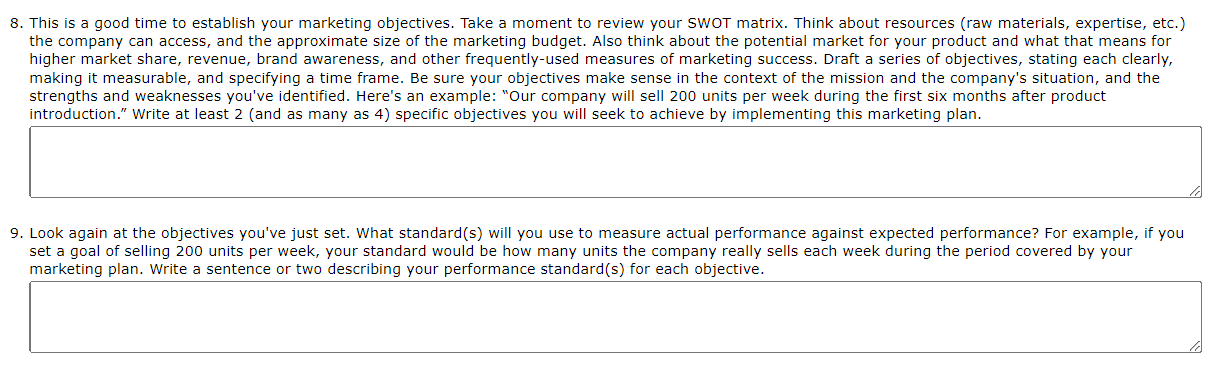
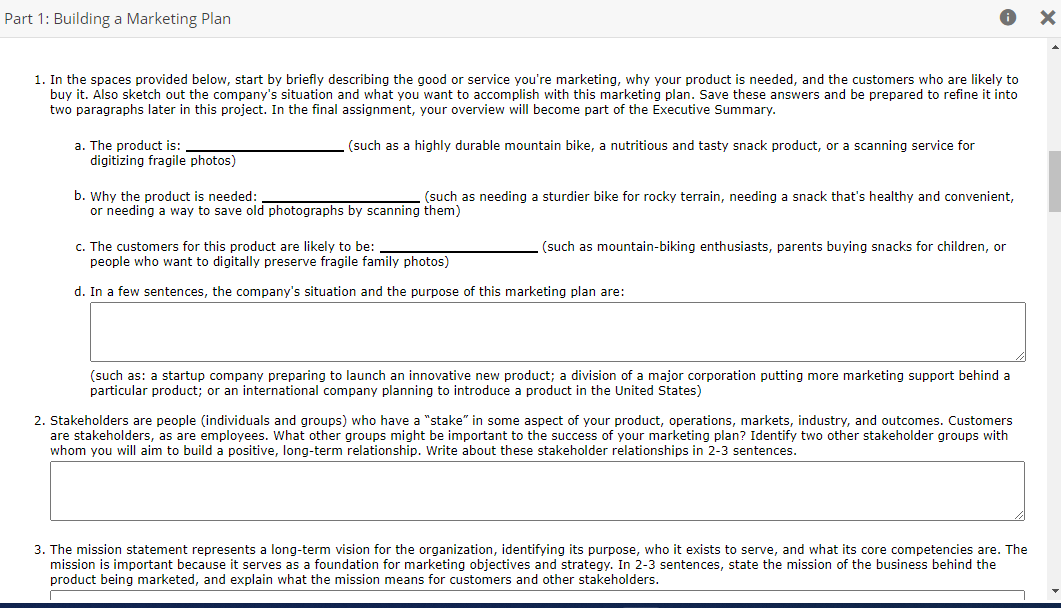
1. In the spaces provided below, start by briefly describing the good or service you're marketing, why your product is needed, and the customers who are likely to buy it. Also sketch out the company's situation and what you want to accomplish with this marketing plan. Save these answers and be prepared to refine it into two paragraphs later in this project. In the final assignment, your overview will become part of the Executive Summary. a. The product is: (such as a highly durable mountain bike, a nutritious and tasty snack product, or a scanning service for digitizing fragile photos) b. Why the product is needed: (such as needing a sturdier bike for rocky terrain, needing a snack that's healthy and convenient, or needing a way to save old photographs by scanning them) c. The customers for this product are likely to be: (such as mountain-biking enthusiasts, parents buying snacks for children, or people who want to digitally preserve fragile family photos) d. In a few sentences, the company's situation and the purpose of this marketing plan are: (such as: a startup company preparing to launch an innovative new product; a division of a major corporation putting more marketing support behind a particular product; or an international company planning to introduce a product in the United States) 2. Stakeholders are people (individuals and groups) who have a "stake" in some aspect of your product, operations, markets, industry, and outcomes. Customers are stakeholders, as are employees. What other groups might be important to the success of your marketing plan? Identify two other stakeholder groups with 3. The mission statement represents a long-term vision for the organization, identifying its purpose, who it exists to serve, and what its core competencies are. The mission is important because it serves as a foundation for marketing objectives and strategy. In 2-3 sentences, state the mission of the business behind the product being marketed, and explain what the mission means for customers and other stakeholders. 8. This is a good time to establish your marketing objectives. Take a moment to review your SWOT matrix. Think about resources (raw materials, expertise, etc.) the company can access, and the approximate size of the marketing budget. Also think about the potential market for your product and what that means for higher market share, revenue, brand awareness, and other frequently-used measures of marketing success. Draft a series of objectives, stating each clearly, making it measurable, and specifying a time frame. Be sure your objectives make sense in the context of the mission and the company's situation, and the strengths and weaknesses you've identified. Here's an example: "Our company will sell 200 units per week during the first six months after product introduction." Write at least 2 (and as many as 4) specific objectives you will seek to achieve by implementing this marketing plan. 9. Look again at the objectives you've just set. What standard(s) will you use to measure actual performance against expected performance? For example, if you set a goal of selling 200 units per week, your standard would be how many units the company really sells each week during the period covered by your marketing plan. Write a sentence or two describing your performance standard(s) for each objective. 1. In the spaces provided below, start by briefly describing the good or service you're marketing, why your product is needed, and the customers who are likely to buy it. Also sketch out the company's situation and what you want to accomplish with this marketing plan. Save these answers and be prepared to refine it into two paragraphs later in this project. In the final assignment, your overview will become part of the Executive Summary. a. The product is: (such as a highly durable mountain bike, a nutritious and tasty snack product, or a scanning service for digitizing fragile photos) b. Why the product is needed: (such as needing a sturdier bike for rocky terrain, needing a snack that's healthy and convenient, or needing a way to save old photographs by scanning them) c. The customers for this product are likely to be: (such as mountain-biking enthusiasts, parents buying snacks for children, or people who want to digitally preserve fragile family photos) d. In a few sentences, the company's situation and the purpose of this marketing plan are: (such as: a startup company preparing to launch an innovative new product; a division of a major corporation putting more marketing support behind a particular product; or an international company planning to introduce a product in the United States) 2. Stakeholders are people (individuals and groups) who have a "stake" in some aspect of your product, operations, markets, industry, and outcomes. Customers are stakeholders, as are employees. What other groups might be important to the success of your marketing plan? Identify two other stakeholder groups with 3. The mission statement represents a long-term vision for the organization, identifying its purpose, who it exists to serve, and what its core competencies are. The mission is important because it serves as a foundation for marketing objectives and strategy. In 2-3 sentences, state the mission of the business behind the product being marketed, and explain what the mission means for customers and other stakeholders. 8. This is a good time to establish your marketing objectives. Take a moment to review your SWOT matrix. Think about resources (raw materials, expertise, etc.) the company can access, and the approximate size of the marketing budget. Also think about the potential market for your product and what that means for higher market share, revenue, brand awareness, and other frequently-used measures of marketing success. Draft a series of objectives, stating each clearly, making it measurable, and specifying a time frame. Be sure your objectives make sense in the context of the mission and the company's situation, and the strengths and weaknesses you've identified. Here's an example: "Our company will sell 200 units per week during the first six months after product introduction." Write at least 2 (and as many as 4) specific objectives you will seek to achieve by implementing this marketing plan. 9. Look again at the objectives you've just set. What standard(s) will you use to measure actual performance against expected performance? For example, if you set a goal of selling 200 units per week, your standard would be how many units the company really sells each week during the period covered by your marketing plan. Write a sentence or two describing your performance standard(s) for each objective









 Study Help