







Question: 4. Note: the objective of this problem is to take you through an example of how one might think about consequences and trade-offs involved in
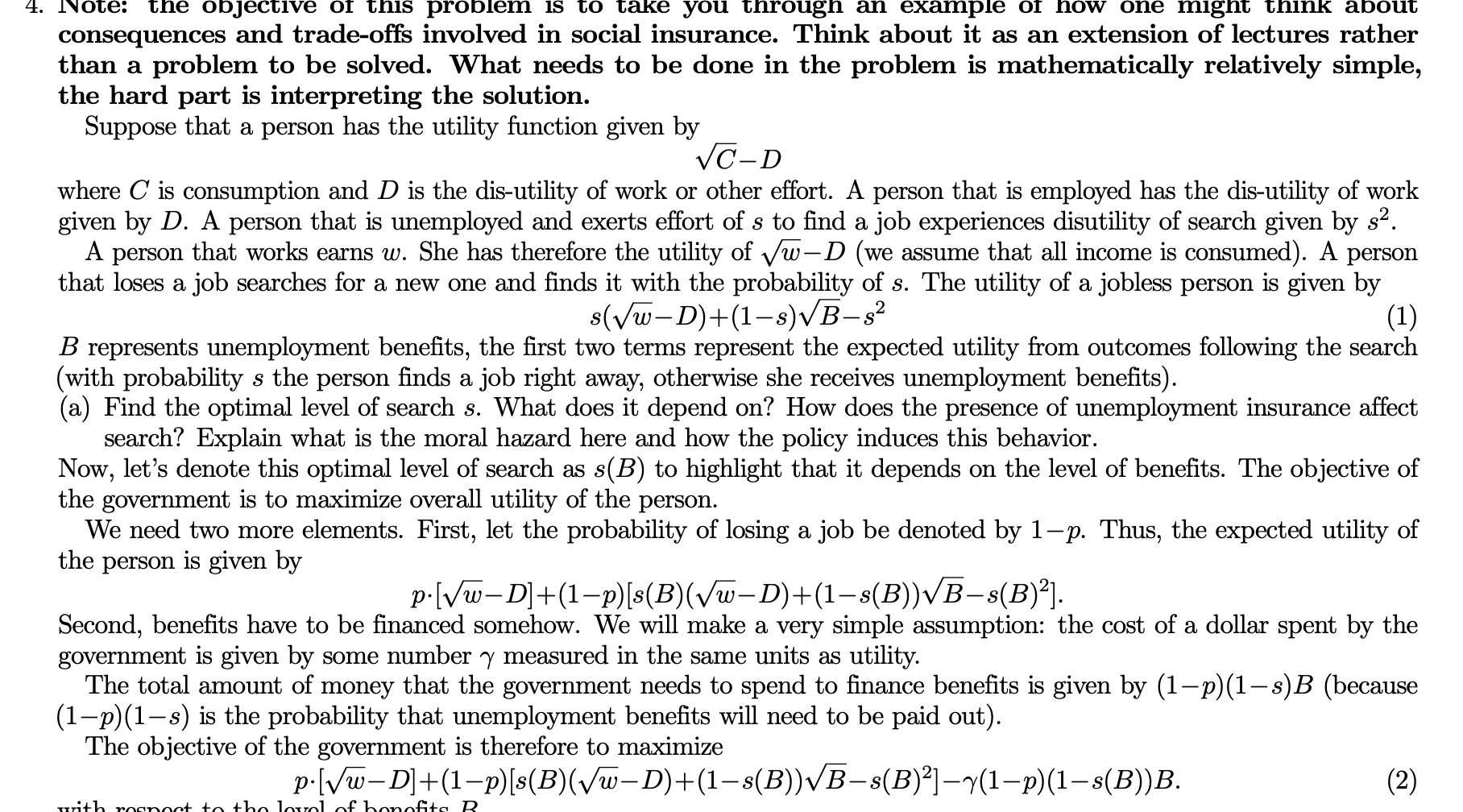
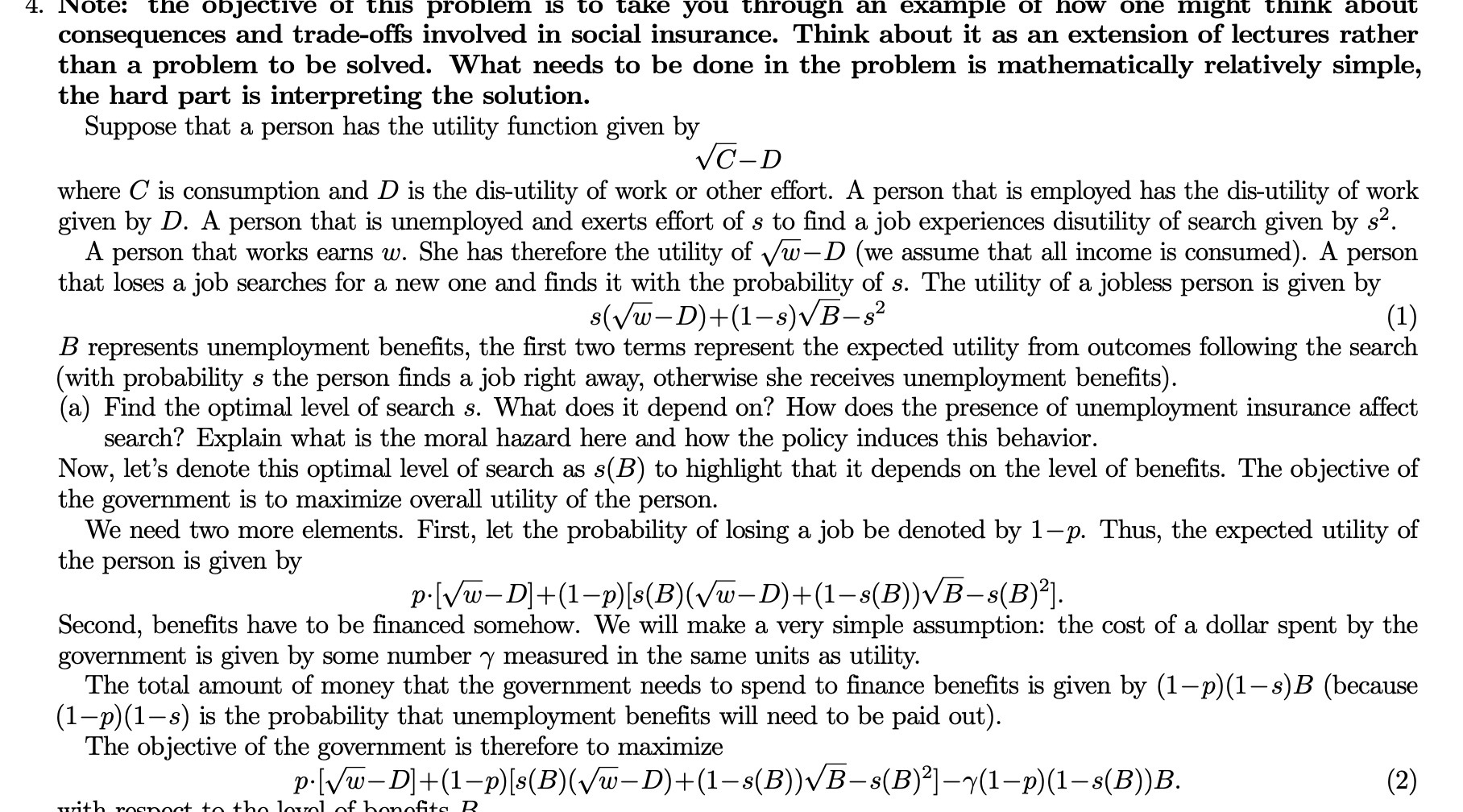
4. Note: the objective of this problem is to take you through an example of how one might think about consequences and trade-offs involved in social insurance. Think about it as an extension of lectures rather than a problem to be solved. What needs to be done in the problem is mathematically relatively simple, the hard part is interpreting the solution. Suppose that a person has the utility function given by VC-D where C is consumption and D is the dis-utility of work or other effort. A person that is employed has the dis-utility of work given by D. A person that is unemployed and exerts effort of s to find a job experiences disutility of search given by s. A person that works earns w. She has therefore the utility of Vw-D (we assume that all income is consumed). A person that loses a job searches for a new one and finds it with the probability of s. The utility of a jobless person is given by s( Vw-D)+(1-s)VB-$2 (1) B represents unemployment benefits, the first two terms represent the expected utility from outcomes following the search (with probability s the person finds a job right away, otherwise she receives unemployment benefits). (a) Find the optimal level of search s. What does it depend on? How does the presence of unemployment insurance affect search? Explain what is the moral hazard here and how the policy induces this behavior. Now, let's denote this optimal level of search as s(B) to highlight that it depends on the level of benefits. The objective of the government is to maximize overall utility of the person. We need two more elements. First, let the probability of losing a job be denoted by 1-p. Thus, the expected utility of the person is given by p.[Vw-D]+(1-p)[s(B)(Vw-D)+(1-s(B))VB-s(B)2]. Second, benefits have to be financed somehow. We will make a very simple assumption: the cost of a dollar spent by the government is given by some number y measured in the same units as utility. The total amount of money that the government needs to spend to finance benefits is given by (1-p)(1-s) B (because (1-p)(1-s) is the probability that unemployment benefits will need to be paid out). The objective of the government is therefore to maximize p.[Vw-D]+(1-p) [s(B)(Vw-D)+(1-s(B))VB-s(B)2]-v(1-p)(1-s(B))B. (2) of he
Step by Step Solution
There are 3 Steps involved in it

Get step-by-step solutions from verified subject matter experts
 Study Help