



Question: (4) Perfect complements. Marcos loves apple pie but he does not like apple pie, Q1, by itself or vanilla ice cream, Q2, by itself. That
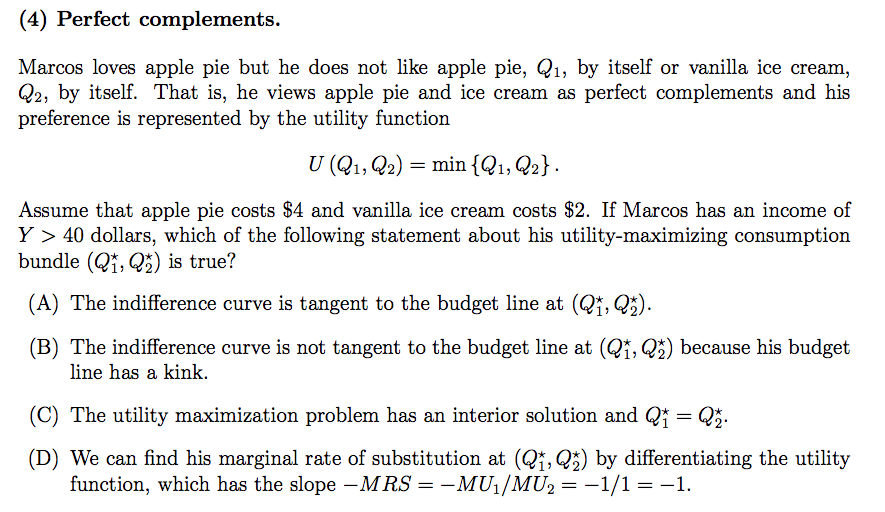
(4) Perfect complements. Marcos loves apple pie but he does not like apple pie, Q1, by itself or vanilla ice cream, Q2, by itself. That is, he views apple pie and ice cream as perfect complements and his preference is represented by the utility function U (Q1, Q2) = min {Q1, Q2} . Assume that apple pie costs $4 and vanilla ice cream costs $2. If Marcos has an income of Y > 40 dollars, which of the following statement about his utility-maximizing consumption bundle (Q1, Q2) is true? (A) The indifference curve is tangent to the budget line at (Q;, Q2). (B) The indifference curve is not tangent to the budget line at (Q1, @2) because his budget line has a kink. (C) The utility maximization problem has an interior solution and Qt = Q2. (D) We can find his marginal rate of substitution at (Q:, Q:) by differentiating the utility function, which has the slope -MRS = -MU1/MU2 = -1/1 = -1
Step by Step Solution
There are 3 Steps involved in it

Get step-by-step solutions from verified subject matter experts