







Question: 4) Please answer full question (a-c) showing work . Ensure answer is correct for thumbs up!!! 4. In mathematics, the n-th term (n> 1) of
4) Please answer full question (a-c) showing work. Ensure answer is correct for thumbs up!!!
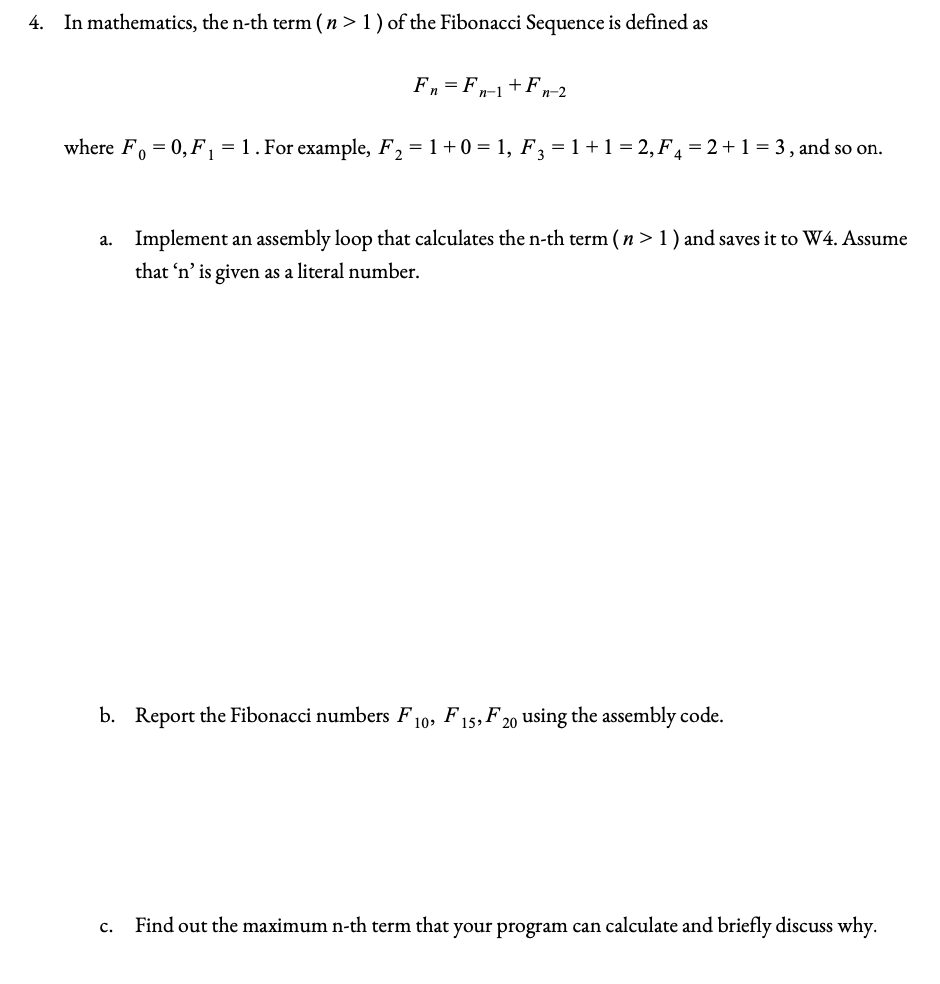
4. In mathematics, the n-th term (n> 1) of the Fibonacci Sequence is defined as Fn = Fn-1 +Fn-2 where F, = 0,F, = 1. For example, F, = 1+0= 1, F2 = 1+1 = 2, F4 = 2+1 = 3, and so on. a. Implement an assembly loop that calculates the n-th term (n> 1) and saves it to W4. Assume that 'n' is given as a literal number. b. Report the Fibonacci numbers F10, F15, F 20 using the assembly code. c. Find out the maximum n-th term that your program can calculate and briefly discuss why. 4. In mathematics, the n-th term (n> 1) of the Fibonacci Sequence is defined as Fn = Fn-1 +Fn-2 where F, = 0,F, = 1. For example, F, = 1+0= 1, F2 = 1+1 = 2, F4 = 2+1 = 3, and so on. a. Implement an assembly loop that calculates the n-th term (n> 1) and saves it to W4. Assume that 'n' is given as a literal number. b. Report the Fibonacci numbers F10, F15, F 20 using the assembly code. c. Find out the maximum n-th term that your program can calculate and briefly discuss why
Step by Step Solution
There are 3 Steps involved in it

Get step-by-step solutions from verified subject matter experts
 Study Help