







Question: (4%) Problem 8: A positively charged particle @1 = 45 nC is held immobile at the origin. A negatively charged particle @2 = -12 nC
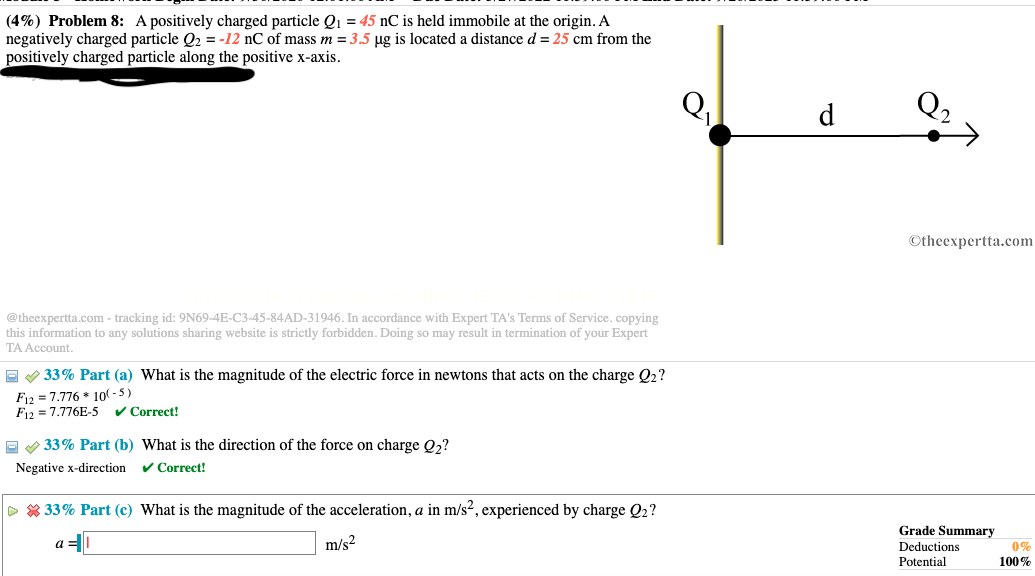
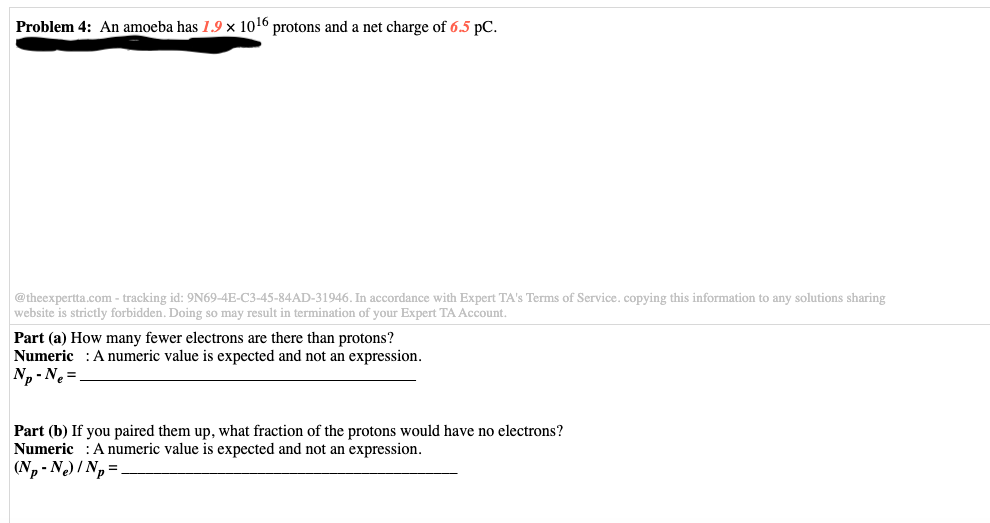
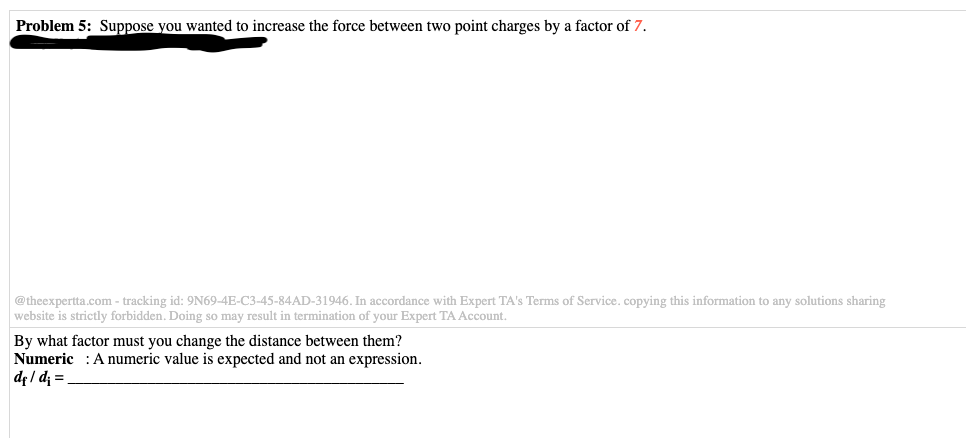
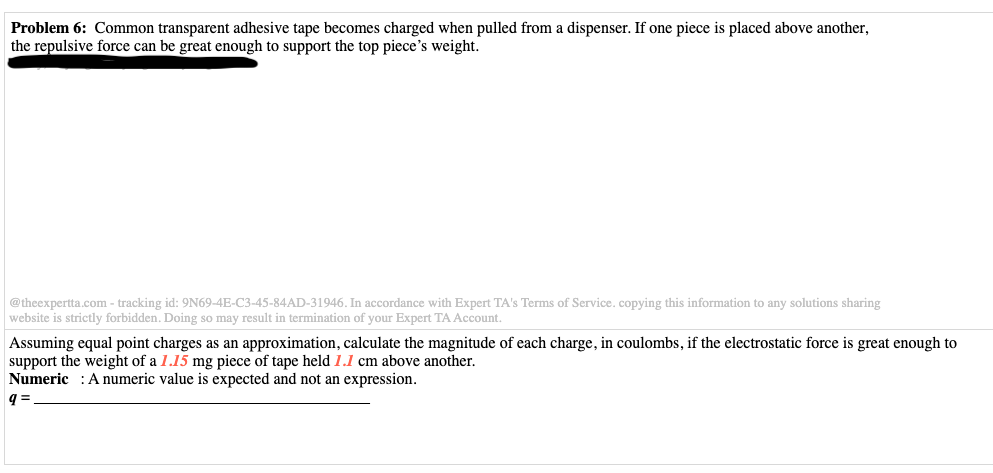
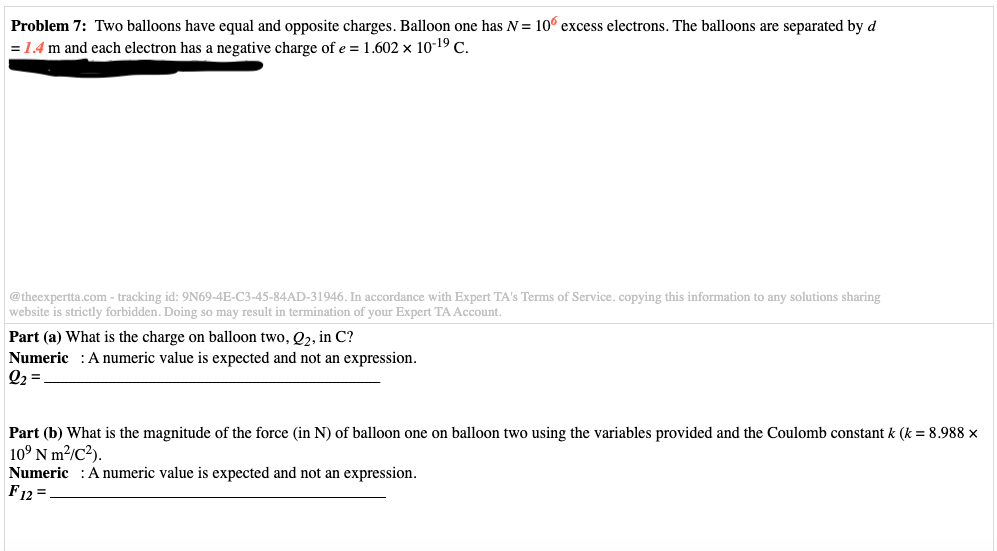
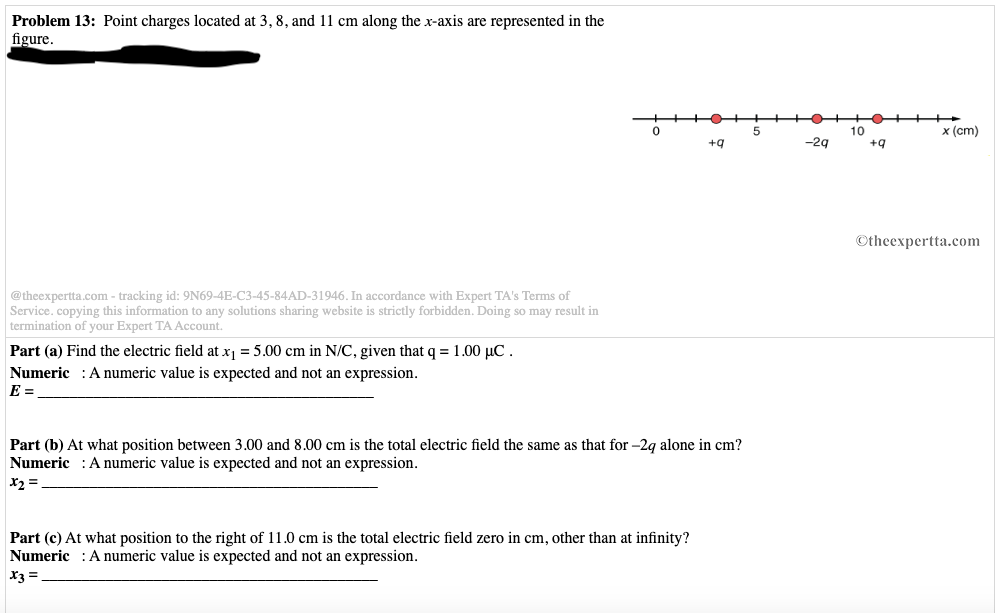
(4%) Problem 8: A positively charged particle @1 = 45 nC is held immobile at the origin. A negatively charged particle @2 = -12 nC of mass m = 3.5 pg is located a distance d = 25 cm from the positively charged particle along the positive x-axis. Q1 d Q2 Otheexpertta.com @theexpertta.com - tracking id: 9N69-4E-C3-45-84AD-31946. In accordance with Expert TA's Terms of Service. copying this information to any solutions sharing website is strictly forbidden. Doing so may result in termination of your Expert TA Account. 33% Part (a) What is the magnitude of the electric force in newtons that acts on the charge Oz? F12 = 7.776 * 10(-5) F12 = 7.776E-5 . Correct! 33% Part (b) What is the direction of the force on charge @2? Negative x-direction . Correct! *33% Part (c) What is the magnitude of the acceleration, a in m/s, experienced by charge Oz? Grade Summary a= 1 m/$2 Deductions Potential 100 %Problem 4: An amoeba has 1.9 x 10¹⁰ protons and a net charge of 6.5 pC. @theexpertta.com - tracking id: 9N69-4E-C3-45-84AD-31946. In accordance with Expert TA's Terms of Service. copying this information to any solutions sharing website is strictly forbidden. Doing so may result in termination of your Expert TA Account. Part (a) How many fewer electrons are there than protons? Numeric : A numeric value is expected and not an expression. Np - Ne = Part (b) If you paired them up, what fraction of the protons would have no electrons? Numeric : A numeric value is expected and not an expression. (No - NJ)INp =Problem 5: Suppose you wanted to increase the force between two point charges by a factor of 7. @theexpertta.com - tracking id: 9N69-4E-C3-45-84AD-31946. In accordance with Expert TA's Terms of Service. copying this information to any solutions sharing website is strictly forbidden. Doing so may result in termination of your Expert TA Account. By what factor must you change the distance between them? Numeric : A numeric value is expected and not an expression. de/ di =Problem 6: Common transparent adhesive tape becomes charged when pulled from a dispenser. If one piece is placed above another, the gulsive force can be great enough to support the top piece 's weight. (r'thccxpcmucom tracking id: 93:69 4E {.13 45 MAD 3J4EL In accordance with Export T'A's Terms of Sort-ice. copying this information to on); solutions shoring n'cbsilc is strictly lrhiddcn. Doing so may result in termination of your Expert TA Account. Assuming equal point charges as an approximation. calculate the magnitude of each charge. in coulombs, if the electrostatic force is great enough to support the weight of a 1.15 mg piece of tape held 1.1 cm above another. Numeric : A numeric value is expected and not an expression. q: Problem 7: Two balloons have equal and opposite charges. Balloon one has / = 10 excess electrons. The balloons are separated by d = 1.4 m and each electron has a negative charge of e = 1.602 x 10⁻¹⁹ C. @theexpertta.com - tracking id: 9N69-4E-C3-45-84AD-31946. In accordance with Expert TA's Terms of Service. copying this information to any solutions sharing website is strictly forbidden. Doing so may result in termination of your Expert TA Account. Part (a) What is the charge on balloon two, 02, in C? Numeric : A numeric value is expected and not an expression. 02 = Part (b) What is the magnitude of the force (in N) of balloon one on balloon two using the variables provided and the Coulomb constant k (k = 8.988 x 10⁹ N m /C2). Numeric : A numeric value is expected and not an expression. F12 =Problem 13: Point charges located at 3, 8, and 11 cm along the x-axis are represented in the figure. + 5 10 x (cm) +q -2q +q Otheexpertta.com @theexpertta.com - tracking id: 9N69-4E-C3-45-84AD-31946. In accordance with Expert TA's Terms of Service. copying this information to any solutions sharing website is strictly forbidden. Doing so may result in termination of your Expert TA Account. Part (a) Find the electric field at x1 = 5.00 cm in N/C, given that q = 1.00 uC . Numeric : A numeric value is expected and not an expression. E = Part (b) At what position between 3.00 and 8.00 cm is the total electric field the same as that for -2q alone in cm? Numeric : A numeric value is expected and not an expression. Part (c) At what position to the right of 11.0 cm is the total electric field zero in cm, other than at infinity? Numeric : A numeric value is expected and not an expression. *3 =
Step by Step Solution
There are 3 Steps involved in it

Get step-by-step solutions from verified subject matter experts
 Study Help