







Question: 4. Propose a distributed algorithm to color the nodes of a tree (with no designated root) using exactly two colors 0 and 1, such that
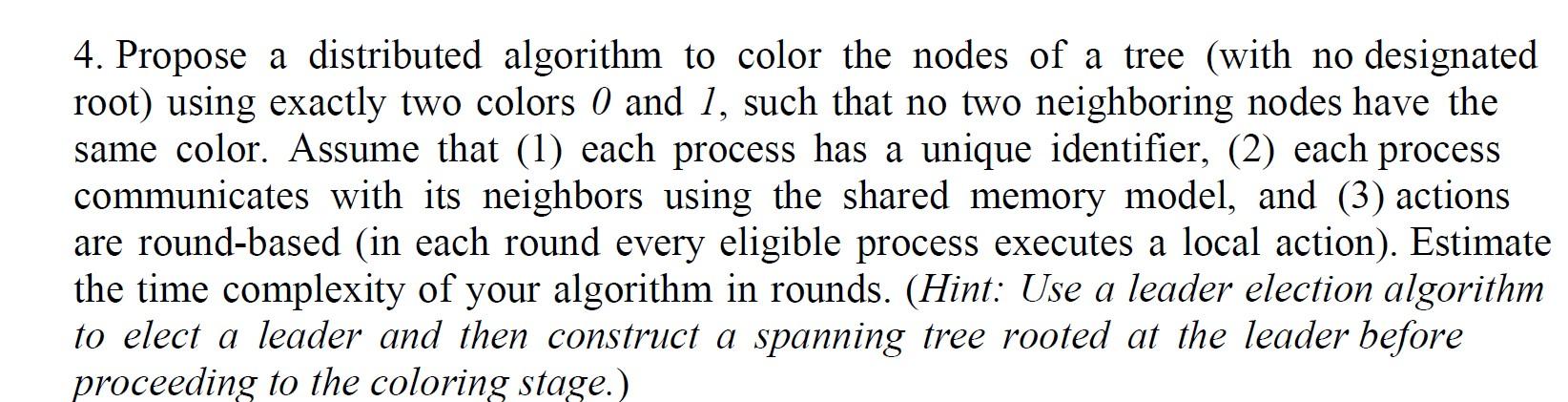
4. Propose a distributed algorithm to color the nodes of a tree (with no designated root) using exactly two colors 0 and 1, such that no two neighboring nodes have the same color. Assume that (1) each process has a unique identifier, (2) each process communicates with its neighbors using the shared memory model, and (3) actions are round-based in each round every eligible process executes a local action). Estimate the time complexity of your algorithm in rounds. (Hint: Use a leader election algorithm to elect a leader and then construct a spanning tree rooted at the leader before proceeding to the coloring stage.) 4. Propose a distributed algorithm to color the nodes of a tree (with no designated root) using exactly two colors 0 and 1, such that no two neighboring nodes have the same color. Assume that (1) each process has a unique identifier, (2) each process communicates with its neighbors using the shared memory model, and (3) actions are round-based in each round every eligible process executes a local action). Estimate the time complexity of your algorithm in rounds. (Hint: Use a leader election algorithm to elect a leader and then construct a spanning tree rooted at the leader before proceeding to the coloring stage.)
Step by Step Solution
There are 3 Steps involved in it

Get step-by-step solutions from verified subject matter experts
 Study Help