







Question: 4) Real-World Data Analysis (1.5 pt) In 1956, E. P. Kennedy and S. B. Weiss published their study of membrane lipid phosphatidylcholine (lecithin) synthesis in
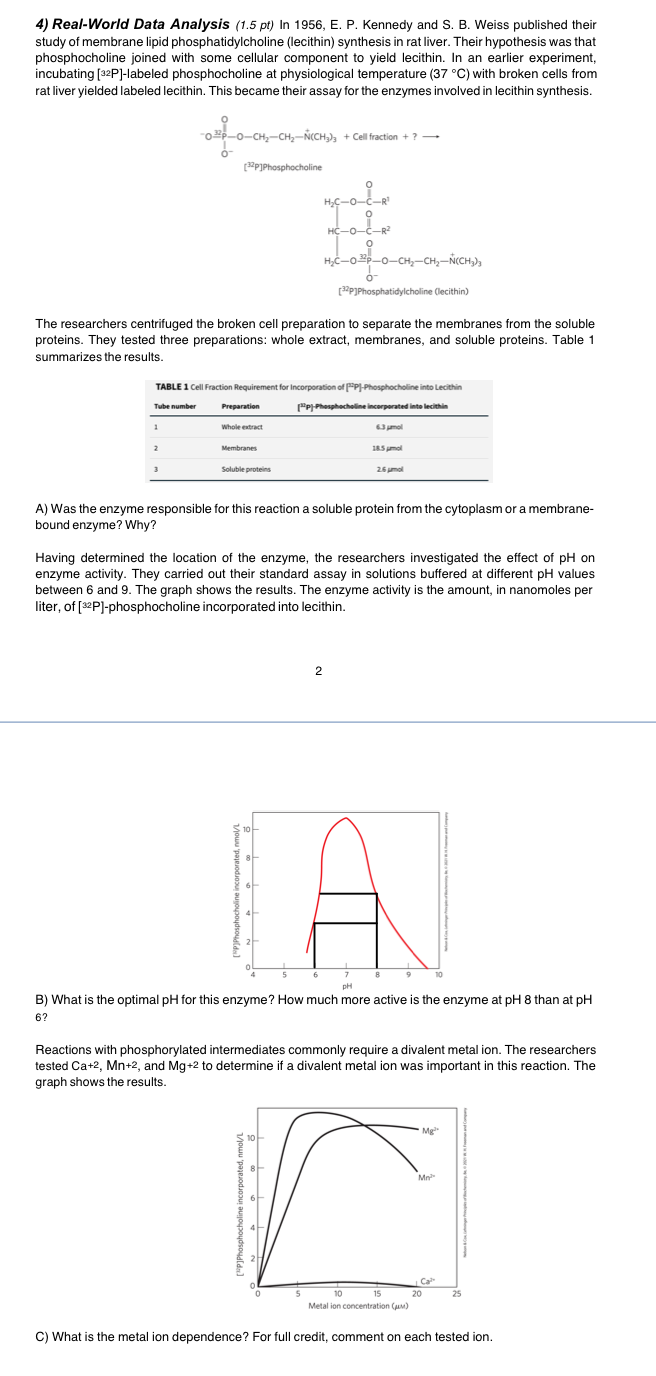
4) Real-World Data Analysis (1.5 pt) In 1956, E. P. Kennedy and S. B. Weiss published their study of membrane lipid phosphatidylcholine (lecithin) synthesis in rat liver. Their hypothesis was that phosphocholine joined with some cellular component to yield lecithin. In an earlier experiment, incubating [32P]-labeled phosphocholine at physiological temperature (37C) with broken cells from rat liver yielded labeled lecithin. This became their assay for the enzymes involved in lecithin synthesis. The researchers centrifuged the broken cell preparation to separate the membranes from the soluble proteins. They tested three preparations: whole extract, membranes, and soluble proteins. Table 1 summarizes the results. A) Was the enzyme responsible for this reaction a soluble protein from the cytoplasm or a membranebound enzyme? Why? Having determined the location of the enzyme, the researchers investigated the effect of pH on enzyme activity. They carried out their standard assay in solutions buffered at different pH values between 6 and 9 . The graph shows the results. The enzyme activity is the amount, in nanomoles per liter, of [32P]-phosphocholine incorporated into lecithin. 2 B) What is the optimal pH for this enzyme? How much more active is the enzyme at pH8 than at pH 6 ? Reactions with phosphorylated intermediates commonly require a divalent metal ion. The researchers tested Ca+2,Mn+2, and Mg+2 to determine if a divalent metal ion was important in this reaction. The graph shows the results. C) What is the metal ion dependence? For full credit, comment on each tested ion
Step by Step Solution
There are 3 Steps involved in it

Get step-by-step solutions from verified subject matter experts
 Study Help