



Question: 4. Should any technology firm be allowed to create a privacy protection system that is so impenetrable that it could never be overridden, regardless of

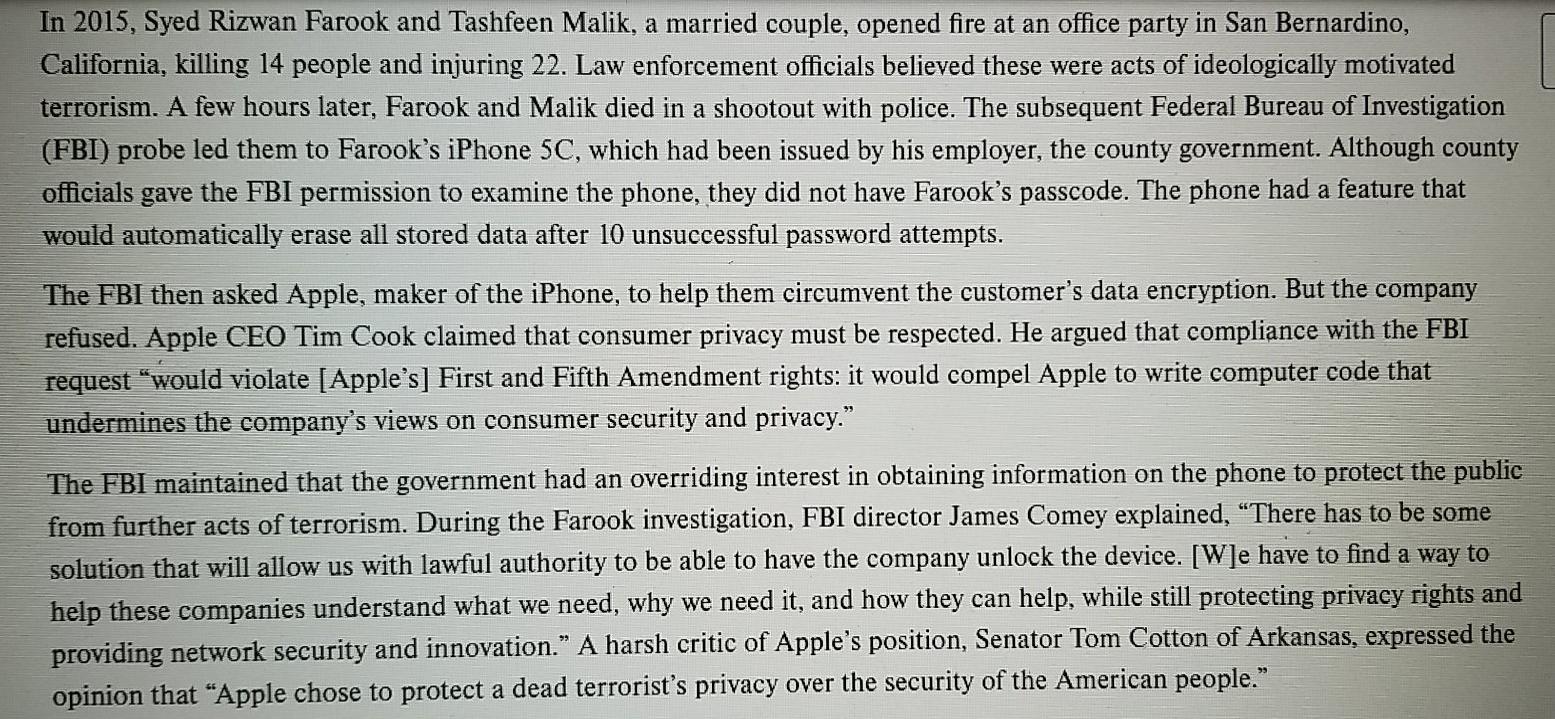
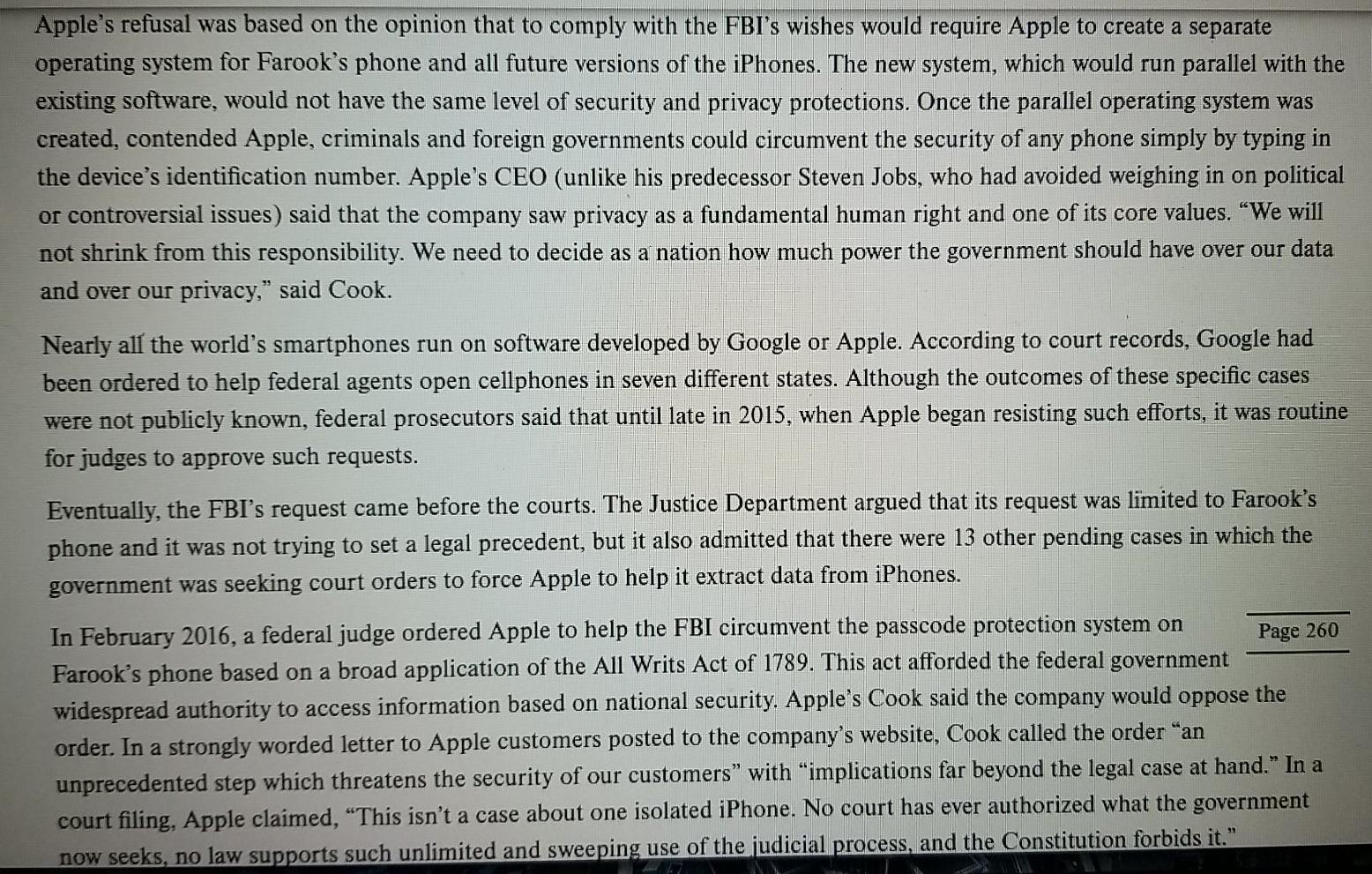
4. Should any technology firm be allowed to create a privacy protection system that is so impenetrable that it could never be overridden, regardless of the government's need for this information? In 2015, Syed Rizwan Farook and Tashfeen Malik, a married couple, opened fire at an office party in San Bernardino, California, killing 14 people and injuring 22. Law enforcement officials believed these were acts of ideologically motivated terrorism. A few hours later, Farook and Malik died in a shootout with police. The subsequent Federal Bureau of Investigation (FBI) probe led them to Farook's iPhone 5C, which had been issued by his employer, the county government. Although county officials gave the FBI permission to examine the phone, they did not have Farook's passcode. The phone had a feature that would automatically erase all stored data after 10 unsuccessful password attempts. The FBI then asked Apple, maker of the iPhone, to help them circumvent the customer's data encryption. But the company refused. Apple CEO Tim Cook claimed that consumer privacy must be respected. He argued that compliance with the FBI request "would violate [Apple's] First and Fifth Amendment rights: it would compel Apple to write computer code that undermines the company's views on consumer security and privacy." The FBI maintained that the government had an overriding interest in obtaining information on the phone to protect the public from further acts of terrorism. During the Farook investigation, FBI director James Comey explained, There has to be some solution that will allow us with lawful authority to be able to have the company unlock the device. [W]e have to find a way to help these companies understand what we need, why we need it, and how they can help, while still protecting privacy rights and providing network security and innovation." A harsh critic of Apple's position, Senator Tom Cotton of Arkansas, expressed the opinion that Apple chose to protect a dead terrorist's privacy over the security of the American people. Apple's refusal was based on the opinion that to comply with the FBI's wishes would require Apple to create a separate operating system for Farook's phone and all future versions of the iPhones. The new system, which would run parallel with the existing software, would not have the same level of security and privacy protections. Once the parallel operating system was created, contended Apple, criminals and foreign governments could circumvent the security of any phone simply by typing in the device's identification number. Apple's CEO (unlike his predecessor Steven Jobs, who had avoided weighing in on political or controversial issues) said that the company saw privacy as a fundamental human right and one of its core values. "We will not shrink from this responsibility. We need to decide as a nation how much power the government should have over our data and over our privacy," said Cook. Nearly all the world's smartphones run on software developed by Google or Apple. According to court records, Google had been ordered to help federal agents open cellphones in seven different states. Although the outcomes of these specific cases were not publicly known, federal prosecutors said that until late in 2015, when Apple began resisting such efforts, it was routine for judges to approve such requests. Eventually, the FBI's request came before the courts. The Justice Department argued that its request was limited to Farook's phone and it was not trying to set a legal precedent, but it also admitted that there were 13 other pending cases in which the government was seeking court orders to force Apple to help it extract data from iPhones. In February 2016, a federal judge ordered Apple to help the FBI circumvent the passcode protection system on Page 260 Farook's phone based on a broad application of the All Writs Act of 1789. This act afforded the federal government widespread authority to access information based on national security. Apple's Cook said the company would oppose the order. In a strongly worded letter to Apple customers posted to the company's website, Cook called the order aan unprecedented step which threatens the security of our customers" with "implications far beyond the legal case at hand." In a court filing, Apple claimed, This isn't a case about one isolated iPhone. No court has ever authorized what the government now seeks, no law supports such unlimited and sweeping use of the judicial process, and the Constitution forbids it
Step by Step Solution
There are 3 Steps involved in it
1 Expert Approved Answer
Step: 1 Unlock

Question Has Been Solved by an Expert!
Get step-by-step solutions from verified subject matter experts
Step: 2 Unlock
Step: 3 Unlock