







Question: 4. (Statistics Review) (a) Suppose a random variable x follow a normal distribution of N[1,2]. Let := 9x2 - 12. +4, compute : = E().
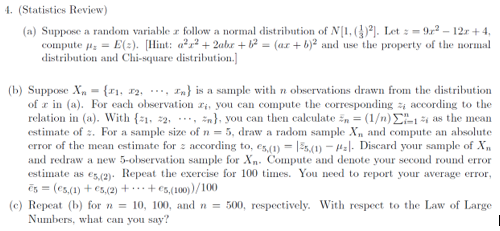
4. (Statistics Review) (a) Suppose a random variable x follow a normal distribution of N[1,2]. Let := 9x2 - 12. +4, compute : = E(). (Hint: ?,? + 2ab + b2 = (ax + b)2 and use the property of the normal distribution and Chi-square distribution (b) Suppose Xo = {11. 12. ..., In} is a sample with n observations drawn from the distribution of e in (a). For each observation is you can compute the corresponding according to the relation in (a). With {1, 2, ..., in, you can then calculate = (1)-17 as the mean estimate of . For a sample size of n = 5, draw a radom sample X, and compute an absolute error of the mean estimate for 2 according to es,(1) = 185.(1) - H2. Discard your sample of X, and redraw a new 5-observation sample for X. Compute and denote your second round error estimate as 5.(2). Repeat the exercise for 100 times. You need to report your average error, 75 = (es,(1) + 5,(2) + ... +6,(100))/100 (c) Repeat (b) for n = 10, 100, and n = 500, respectively. With respect to the Law of Large Numbers, what can you say? 4. (Statistics Review) (a) Suppose a random variable x follow a normal distribution of N[1,2]. Let := 9x2 - 12. +4, compute : = E(). (Hint: ?,? + 2ab + b2 = (ax + b)2 and use the property of the normal distribution and Chi-square distribution (b) Suppose Xo = {11. 12. ..., In} is a sample with n observations drawn from the distribution of e in (a). For each observation is you can compute the corresponding according to the relation in (a). With {1, 2, ..., in, you can then calculate = (1)-17 as the mean estimate of . For a sample size of n = 5, draw a radom sample X, and compute an absolute error of the mean estimate for 2 according to es,(1) = 185.(1) - H2. Discard your sample of X, and redraw a new 5-observation sample for X. Compute and denote your second round error estimate as 5.(2). Repeat the exercise for 100 times. You need to report your average error, 75 = (es,(1) + 5,(2) + ... +6,(100))/100 (c) Repeat (b) for n = 10, 100, and n = 500, respectively. With respect to the Law of Large Numbers, what can you say
Step by Step Solution
There are 3 Steps involved in it

Get step-by-step solutions from verified subject matter experts
 Study Help