







Question: 4. Suppoee you are considering three mutual funds. The first is a stock fund, the second is a long-tern government and corporate bond fund, and
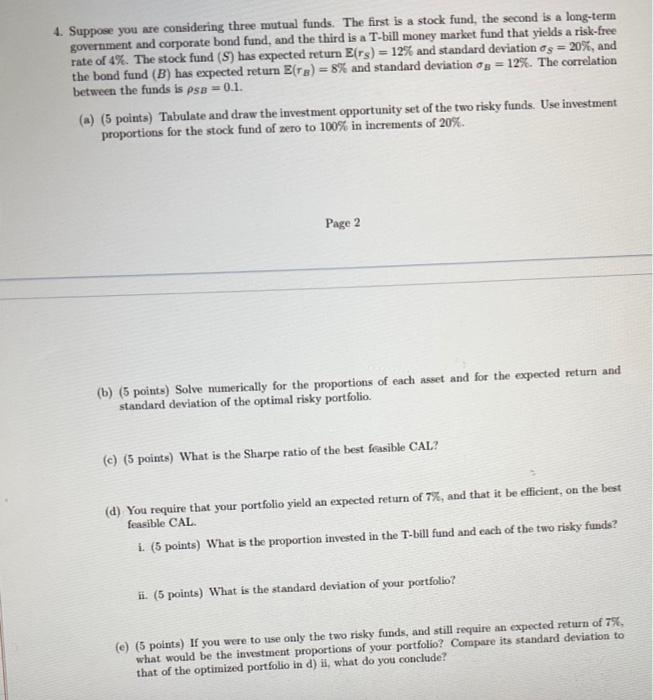
4. Suppoee you are considering three mutual funds. The first is a stock fund, the second is a long-tern government and corporate bond fund, and the third is a T-bill money market fund that yields a risk-free rate of 4%. The stock fund (S) has expected return E(rS)=12% and standard deviation S=20%, and the bond fund (B) has expected return Z(B)=8% and standard deviation B=12%. The correlation between the funds is SB=0.1. (a) (5 points) Tabulate and draw the investment opportunity set of the two risky funds. Use investment proportions for the stock fund of zero to 100% in increments of 20%. Page 2 (b) (5 points) Solve numerically for the proportions of each asset and for the expected return and standard deviation of the optimal risky portfolio. (c) (5 points) What is the Sharpe ratio of the best feasible CAL? (d) You require that your portfolio yield an expected return of 7%, and that it be efficient, on the best feasible CAL. i. (5 points) What is the proportion invested in the T-bill fund and each of the two risky funds? ii. (5 points) What is the standard deviation of your portfolio? (e) (5 points) If you were to use only the two risky funds, and still require an expected return of 7%, what would be the investment proportions of your portfolio? Compare its standard deviation to that of the optimized portfolio in d) in, what do you conclude
Step by Step Solution
There are 3 Steps involved in it

Get step-by-step solutions from verified subject matter experts
 Study Help