







Question: 4. Suppose that A, B, C, D, E are unique files. Suppose that files have been accessed in the order B, D, A, E, B,
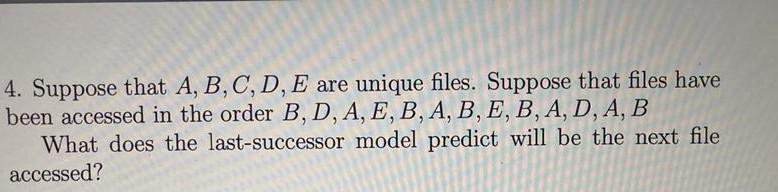
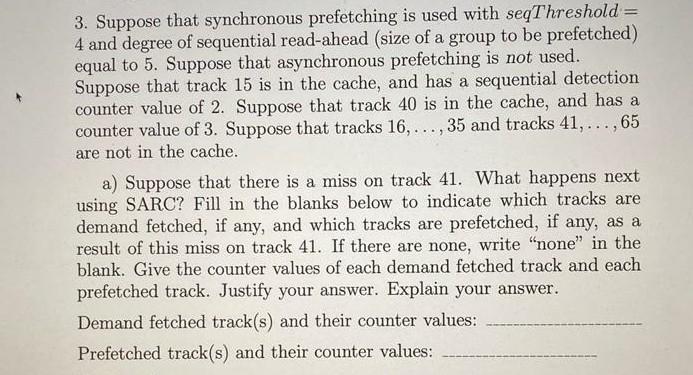
4. Suppose that A, B, C, D, E are unique files. Suppose that files have been accessed in the order B, D, A, E, B, A, B, E, B, A, D, A, B What does the last-successor model predict will be the next file accessed? 3. Suppose that synchronous prefetching is used with seqThreshold = 4 and degree of sequential read-ahead (size of a group to be prefetched) equal to 5. Suppose that asynchronous prefetching is not used. Suppose that track 15 is in the cache, and has a sequential detection counter value of 2. Suppose that track 40 is in the cache, and has a counter value of 3. Suppose that tracks 16, ..., 35 and tracks 41,...,65 are not in the cache. a) Suppose that there is a miss on track 41. What happens next using SARC? Fill in the blanks below to indicate which tracks are demand fetched, if any, and which tracks are prefetched, if any, as a result of this miss on track 41. If there are none, write "none" in the blank. Give the counter values of each demand fetched track and each prefetched track. Justify your answer. Explain your answer. Demand fetched track(s) and their counter values: Prefetched track(s) and their counter values
Step by Step Solution
There are 3 Steps involved in it

Get step-by-step solutions from verified subject matter experts
 Study Help