



Question: 4. Suppose that the consumer initially chooses x = 10, y = 10 when px -py = 10, m = 200. (a) Someone says
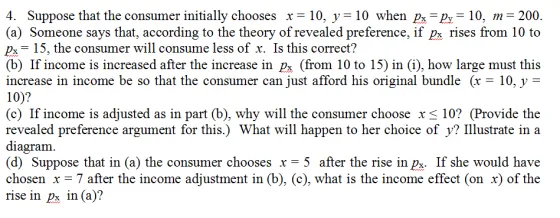
4. Suppose that the consumer initially chooses x = 10, y = 10 when px -py = 10, m = 200. (a) Someone says that, according to the theory of revealed preference, if px rises from 10 to px = 15, the consumer will consume less of x. Is this correct? (b) If income is increased after the increase in px (from 10 to 15) in (i), how large must this increase in income be so that the consumer can just afford his original bundle (x = 10, y = 10)? (c) If income is adjusted as in part (b), why will the consumer choose x 10? (Provide the revealed preference argument for this.) What will happen to her choice of y? Illustrate in a diagram. (d) Suppose that in (a) the consumer chooses x = 5 after the rise in px. If she would have chosen x = 7 after the income adjustment in (b), (c), what is the income effect (on x) of the rise in px in (a)?
Step by Step Solution
There are 3 Steps involved in it
a Yes according to the theory of revealed preference if px rises from 10 to 15 the consumer will con... View full answer

Get step-by-step solutions from verified subject matter experts