







Question: 4. Suppose we were somehow given access to the variable Skill. What is its marginal distribution? 5. Obtain the distributions of (Race, Wage) | Skill
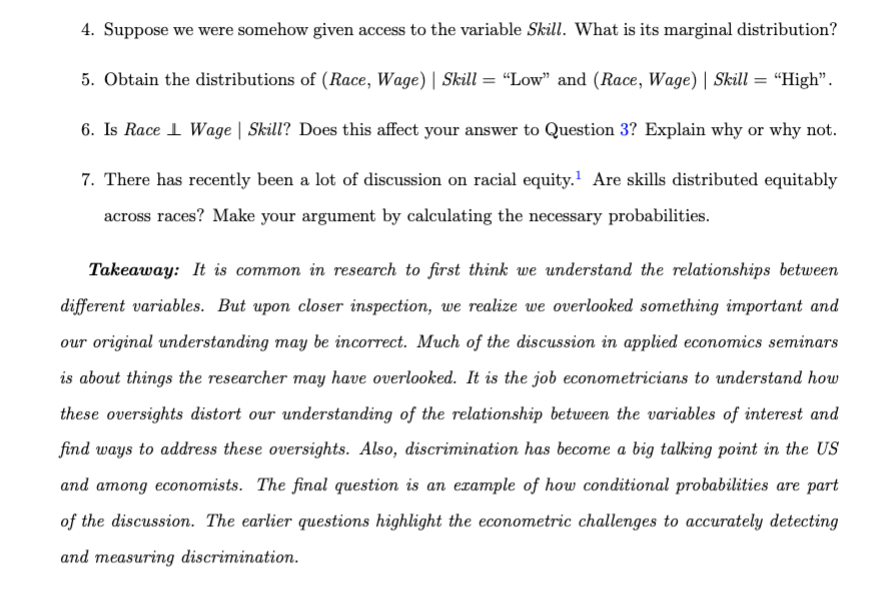
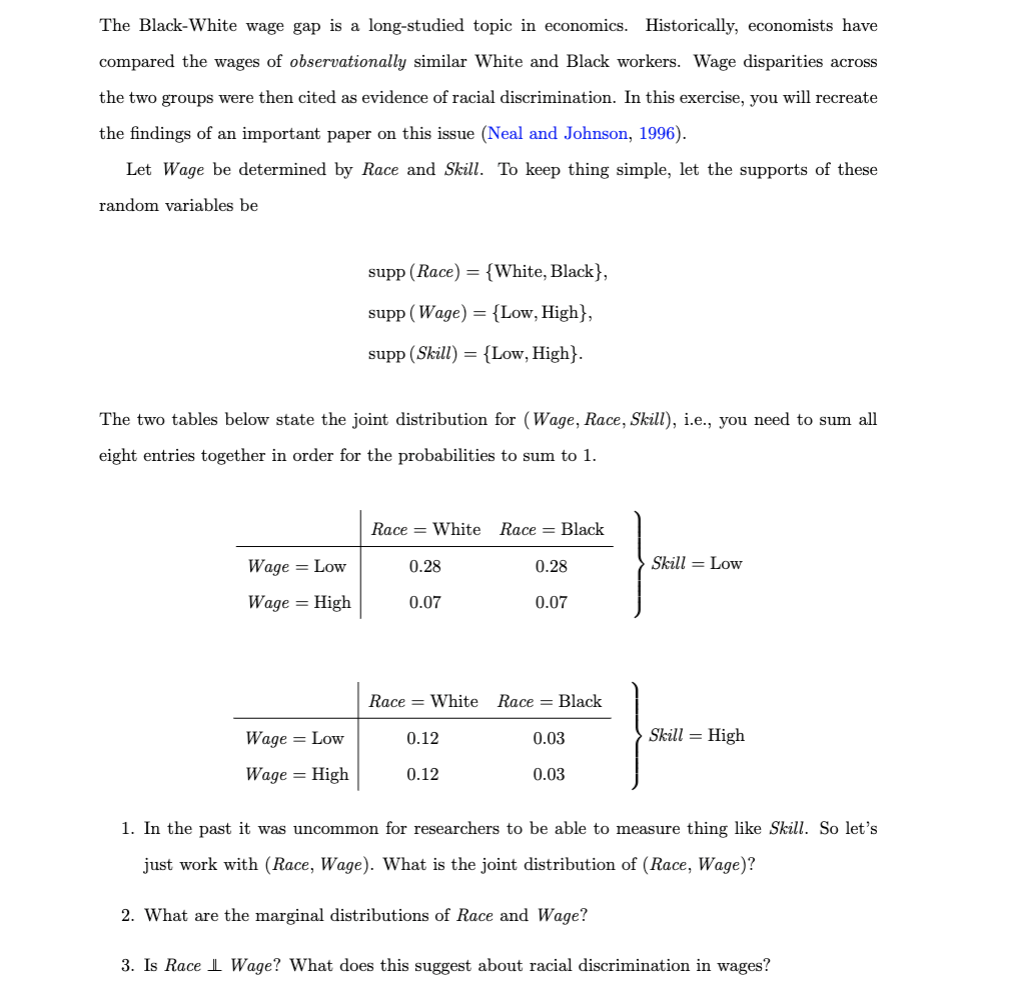
4. Suppose we were somehow given access to the variable Skill. What is its marginal distribution? 5. Obtain the distributions of (Race, Wage) | Skill = "Low" and (Race, Wage) | Skill = "High". 6. Is Race 1 Wage | Skill? Does this affect your answer to Question 3? Explain why or why not. 7. There has recently been a lot of discussion on racial equity.' Are skills distributed equitably across races? Make your argument by calculating the necessary probabilities. Takeaway: It is common in research to first think we understand the relationships between different variables. But upon closer inspection, we realize we overlooked something important and our original understanding may be incorrect. Much of the discussion in applied economics seminars is about things the researcher may have overlooked. It is the job econometricians to understand how these oversights distort our understanding of the relationship between the variables of interest and find ways to address these oversights. Also, discrimination has become a big talking point in the US and among economists. The final question is an example of how conditional probabilities are part of the discussion. The earlier questions highlight the econometric challenges to accurately detecting and measuring discrimination.The Black-White wage gap is a long-studied topic in economics. Historically, economists have compared the wages of observationally similar White and Black workers. Wage disparities across the two groups were then cited as evidence of racial discrimination. In this exercise, you will recreate the findings of an important paper on this issue (Neal and Johnson, 1996). Let Wage be determined by Race and Skill. To keep thing simple, let the supports of these random variables be supp (Race) = {White, Black}, supp ( Wage) = { Low, High }, supp (Skill) = {Low, High}. The two tables below state the joint distribution for ( Wage, Race, Skill), i.e., you need to sum all eight entries together in order for the probabilities to sum to 1. Race = White Race = Black Wage = Low 0.28 0.28 Skill = Low Wage = High 0.07 0.07 Race = White Race = Black Wage = Low 0.12 0.03 Skill = High Wage = High 0.12 0.03 1. In the past it was uncommon for researchers to be able to measure thing like Skill. So let's just work with (Race, Wage). What is the joint distribution of (Race, Wage)? 2. What are the marginal distributions of Race and Wage? 3. Is Race I Wage? What does this suggest about racial discrimination in wages
Step by Step Solution
There are 3 Steps involved in it

Get step-by-step solutions from verified subject matter experts
 Study Help