



Question: 4) The Central Limit Theorem can also be used to help us estimate population proportions of outcomes as long as the outcomes are binomial; i.e.,
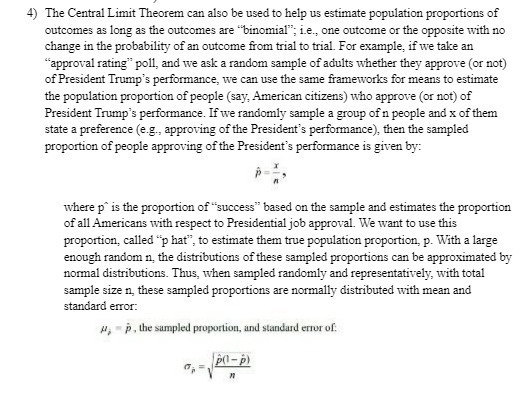
4) The Central Limit Theorem can also be used to help us estimate population proportions of outcomes as long as the outcomes are "binomial"; i.e., one outcome of the opposite with no change in the probability of an outcome from trial to trial. For example, if we take an "approval rating" poll, and we ask a random sample of adults whether they approve (or not) of President Trump's performance, we can use the same frameworks for means to estimate the population proportion of people (say, American citizens) who approve (or not) of President Trump's performance. If we randomly sample a group of n people and x of them state a preference (e.g., approving of the President's performance), then the sampled proportion of people approving of the President's performance is given by: where p" is the proportion of "success" based on the sample and estimates the proportion of all Americans with respect to Presidential job approval. We want to use this proportion, called "p hat", to estimate them true population proportion, p. With a large enough random n, the distributions of these sampled proportions can be approximated by normal distributions. Thus, when sampled randomly and representatively, with total sample size n, these sampled proportions are normally distributed with mean and standard error: #; p , the sampled proportion, and standard error of: P( - P)
Step by Step Solution
There are 3 Steps involved in it

Get step-by-step solutions from verified subject matter experts