







Question: 4. The functions f : {a, b, c, d} -> {a, B, y, 6, E } and g : (a, B, y, 6, E }
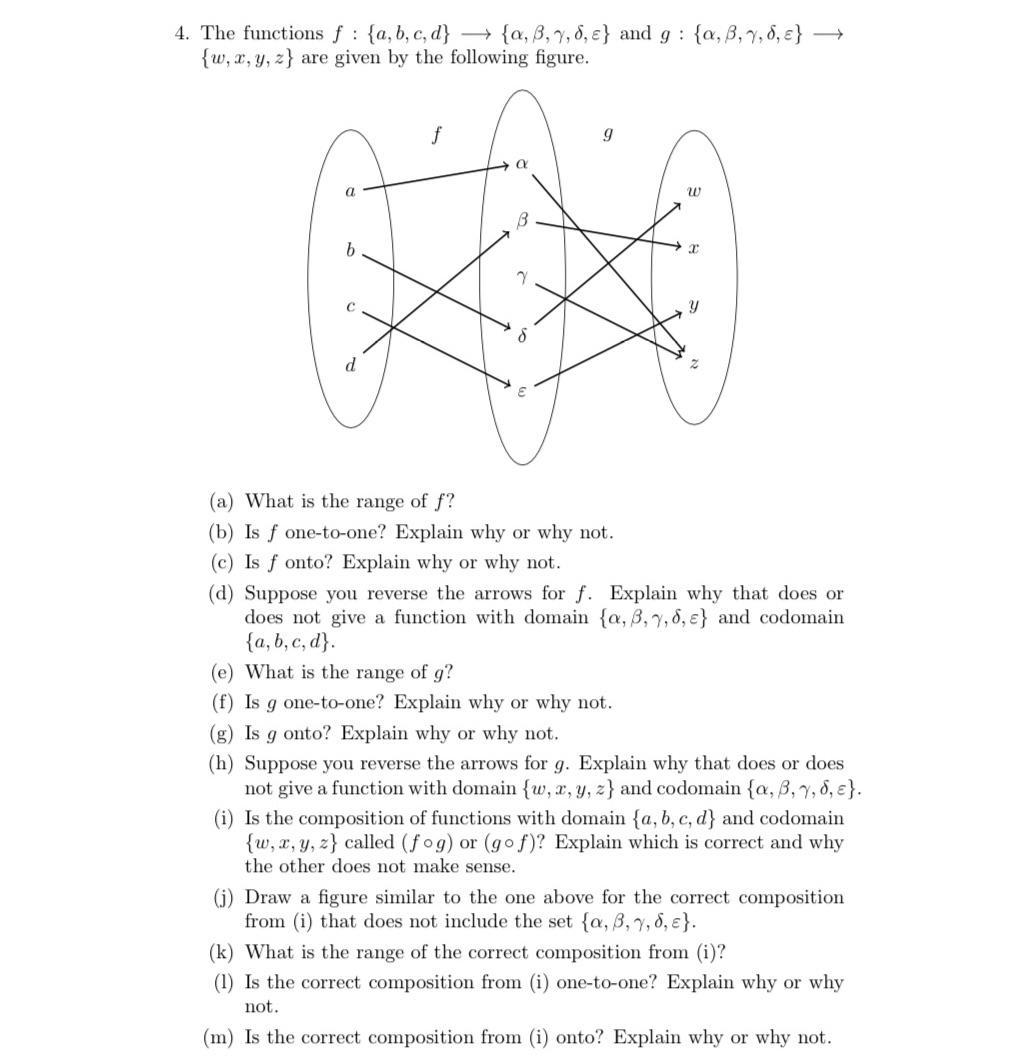
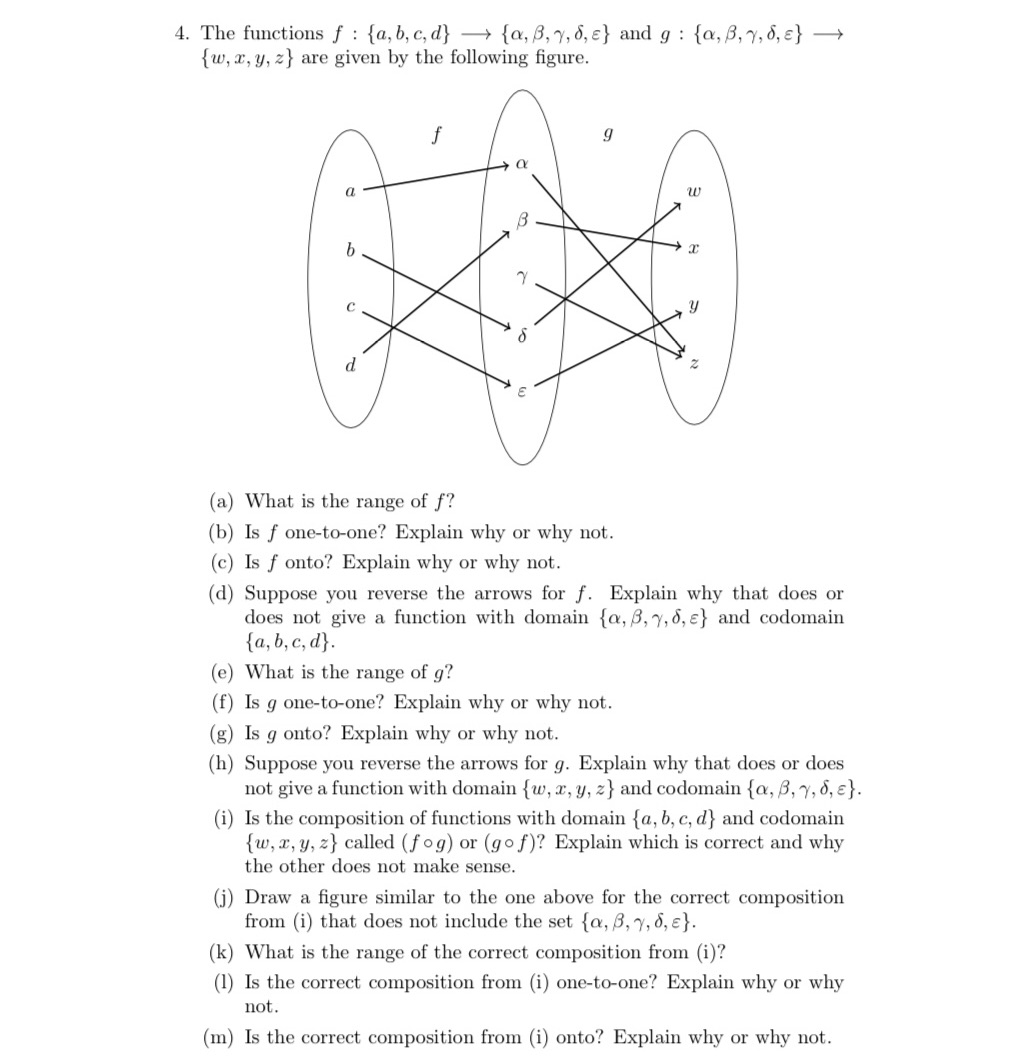
4. The functions f : {a, b, c, d} -> {a, B, y, 6, E } and g : (a, B, y, 6, E } -+ {w, x, y, z} are given by the following figure. (a) What is the range of f? (b) Is f one-to-one? Explain why or why not. (c) Is f onto? Explain why or why not. (d) Suppose you reverse the arrows for f. Explain why that does or does not give a function with domain {o, B, 7,6, } and codomain {a, b, c, d}. (e) What is the range of g? (f) Is g one-to-one? Explain why or why not. (g) Is g onto? Explain why or why not. (h) Suppose you reverse the arrows for g. Explain why that does or does not give a function with domain {w, x, y, z} and codomain {a, B, 7, 6, E}. (i) Is the composition of functions with domain {a, b, c, d'} and codomain {w, x, y, z} called (fog) or (go f)? Explain which is correct and why the other does not make sense. (j) Draw a figure similar to the one above for the correct composition from (i) that does not include the set {a, B, 7, 6, E}. (k) What is the range of the correct composition from (i)? (1) Is the correct composition from (i) one-to-one? Explain why or why not. (m) Is the correct composition from (i) onto? Explain why or why not
Step by Step Solution
There are 3 Steps involved in it

Get step-by-step solutions from verified subject matter experts
 Study Help