







Question: 4. The normal probability density function A. Has only two parameters: variance and covariance B. Has three parameters: mean, skewness, and kurtosis C. Has only
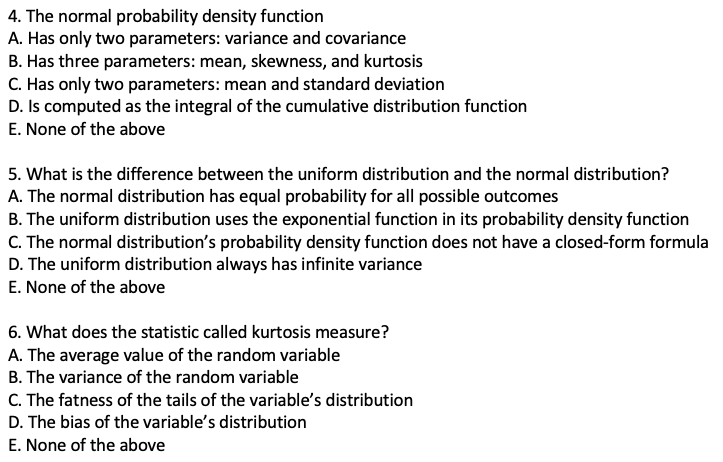
4. The normal probability density function A. Has only two parameters: variance and covariance B. Has three parameters: mean, skewness, and kurtosis C. Has only two parameters: mean and standard deviation D. Is computed as the integral of the cumulative distribution function E. None of the above 5. What is the difference between the uniform distribution and the normal distribution? A. The normal distribution has equal probability for all possible outcomes B. The uniform distribution uses the exponential function in its probability density function C. The normal distribution's probability density function does not have a closed-form formula D. The uniform distribution always has infinite variance E. None of the above 6. What does the statistic called kurtosis measure? A. The average value of the random variable B. The variance of the random variable C. The fatness of the tails of the variable's distribution D. The bias of the variable's distribution E. None of the above
Step by Step Solution
There are 3 Steps involved in it

Get step-by-step solutions from verified subject matter experts
 Study Help