







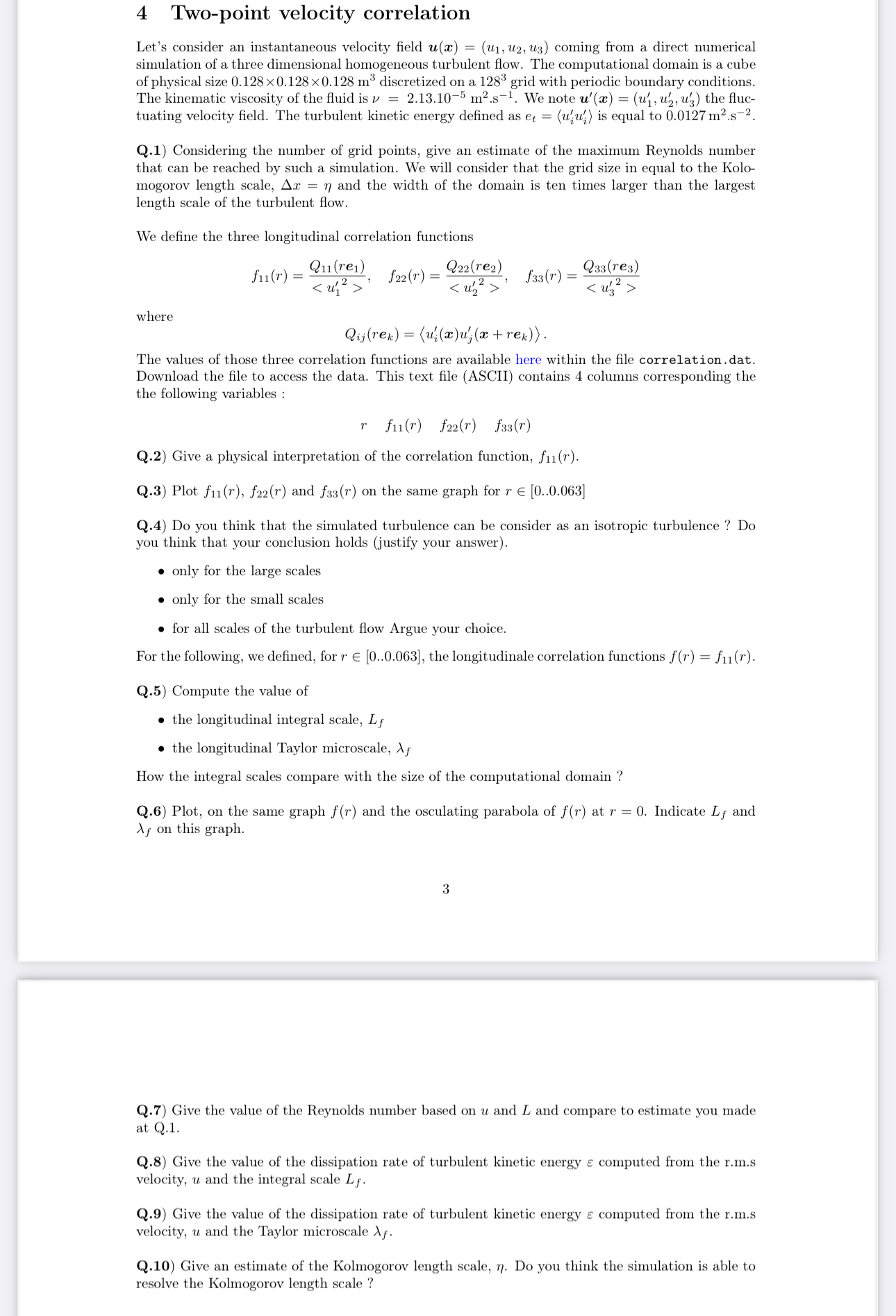
Question: 4 Two - point velocity correlation Let's consider an instantaneous velocity field u ( x ) = ( u 1 , u 2 , u
Twopoint velocity correlation
Let's consider an instantaneous velocity field coming from a direct numerical simulation of a three dimensional homogeneous turbulent flow. The computational domain is a cube of physical size discretized on a grid with periodic boundary conditions. The kinematic viscosity of the fluid is
We note the fluctuating velocity field. The turbulent kinetic energy defined as :: is equal to
Q Considering the number of grid points, give an estimate of the maximum Reynolds number that can be reached by such a simulation. We will consider that the grid size in equal to the Kolomogorov length scale, and the width of the domain is ten times larger than the largest length scale of the turbulent flow.
We define the three longitudinal correlation functions
where
::
The values of those three correlation functions are available here within the file correlation. dat. Download the file to access the data. This text file ASCII contains columns corresponding the the following variables :
Q Give a physical interpretation of the correlation function,
Q Plot and on the same graph for rin
Q Do you think that the simulated turbulence can be consider as an isotropic turbulence Do you think that your conclusion holds justify your answer
only for the large scales
only for the small scales
for all scales of the turbulent flow Argue your choice.
For the following, we defined, for rin the longitudinale correlation functions
Q Compute the value of
the longitudinal integral scale,
the longitudinal Taylor microscale,
How the integral scales compare with the size of the computational domain?
Q Plot, on the same graph and the osculating parabola of at Indicate and on this graph.
Q Give the value of the Reynolds number based on and and compare to estimate you made at Q
Q Give the value of the dissipation rate of turbulent kinetic energy computed from the rms velocity, and the integral scale
Q Give the value of the dissipation rate of turbulent kinetic energy computed from the rms velocity, and the Taylor microscale
Q Give an estimate of the Kolmogorov length scale, Do you think the simulation is able to resolve the Kolmogorov length scale?
Step by Step Solution
There are 3 Steps involved in it
1 Expert Approved Answer
Step: 1 Unlock

Question Has Been Solved by an Expert!
Get step-by-step solutions from verified subject matter experts
Step: 2 Unlock
Step: 3 Unlock
 Study Help