



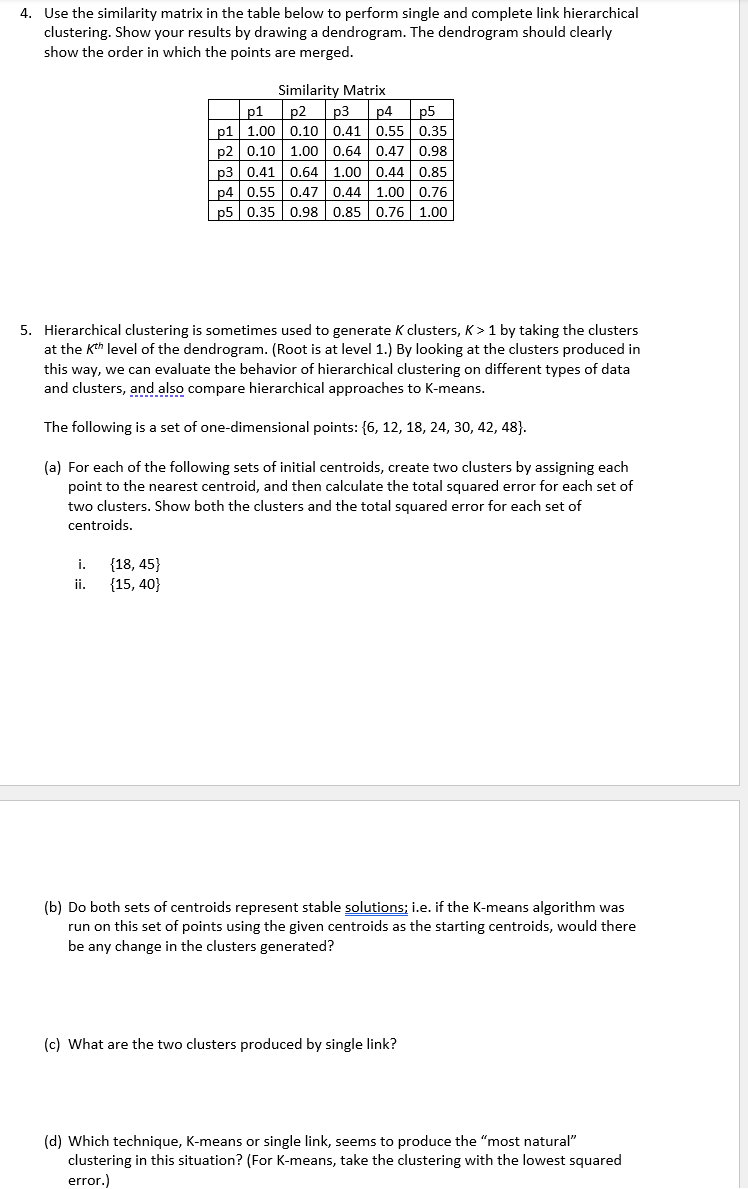
Question: 4 . Use the similarity matrix in the table below to perform single and complete link hierarchical clustering. Show your results by drawing a dendrogram.
Use the similarity matrix in the table below to perform single and complete link hierarchical clustering. Show your results by drawing a dendrogram. The dendrogram should clearly show the order in which the points are merged.
Hierarchical clustering is sometimes used to generate K clusters, K by taking the clusters at the Ktext th level of the dendrogram. Root is at level By looking at the clusters produced in this way, we can evaluate the behavior of hierarchical clustering on different types of data and clusters, and also compare hierarchical approaches to Kmeans.
The following is a set of onedimensional points:
a For each of the following sets of initial centroids, create two clusters by assigning each point to the nearest centroid, and then calculate the total squared error for each set of two clusters. Show both the clusters and the total squared error for each set of centroids.
i
iiquad
b Do both sets of centroids represent stable solutions; ie if the Kmeans algorithm was run on this set of points using the given centroids as the starting centroids, would there be any change in the clusters generated?
c What are the two clusters produced by single link?
d Which technique, Kmeans or single link, seems to produce the "most natural" clustering in this situation? For Kmeans, take the clustering with the lowest squared error.e What definitions of clustering does this natural clustering correspond toWellseparated centerbased, contiguous, or density.
f What wellknown characteristic of the Kmeans algorithm explains the previous behavior?
Step by Step Solution
There are 3 Steps involved in it
1 Expert Approved Answer
Step: 1 Unlock

Question Has Been Solved by an Expert!
Get step-by-step solutions from verified subject matter experts
Step: 2 Unlock
Step: 3 Unlock