







Question: 4. Using Axiomatic Semantics, prove the statements in Question 6 and 7 are not equivalent unless the two operands are equal. Again, be precise with
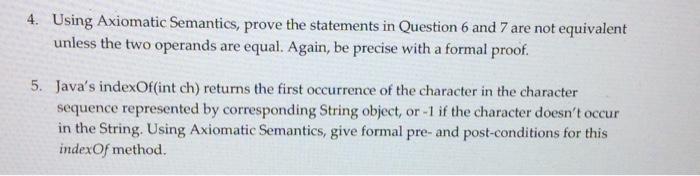
4. Using Axiomatic Semantics, prove the statements in Question 6 and 7 are not equivalent unless the two operands are equal. Again, be precise with a formal proof. 5. Java's indexOf(int ch) returns the first occurrence of the character in the character sequence represented by corresponding String object, or -1 if the character doesn't occur in the String. Using Axiomatic Semantics, give formal pre- and post-conditions for this indexOf method 4. Using Axiomatic Semantics, prove the statements in Question 6 and 7 are not equivalent unless the two operands are equal. Again, be precise with a formal proof. 5. Java's indexOf(int ch) returns the first occurrence of the character in the character sequence represented by corresponding String object, or -1 if the character doesn't occur in the String. Using Axiomatic Semantics, give formal pre- and post-conditions for this indexOf method
Step by Step Solution
There are 3 Steps involved in it

Get step-by-step solutions from verified subject matter experts
 Study Help