







Question: 4. Using the information in the chapter, suppose Home doubles in size and Foreign re- mains the same. Show that an equal proportional increase in
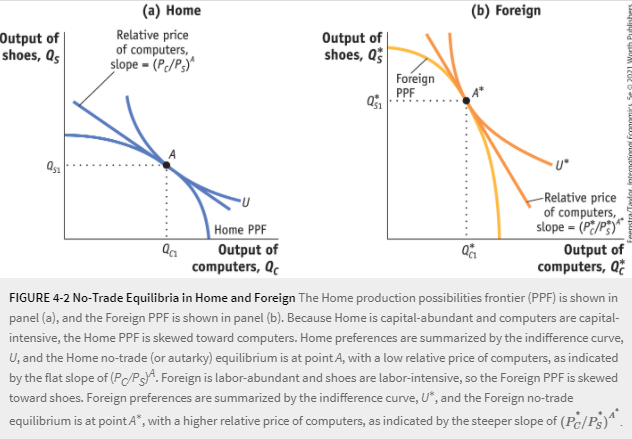
4. Using the information in the chapter, suppose Home doubles in size and Foreign re- mains the same. Show that an equal proportional increase in capital and labor at Home will change the relative price of computers, wage, rental on capital, and the amount traded but not the pattern of trade. Answer: An equal proportional increase in Home's capital and labor does not change its relative factor endowments so that the labor/ capital ratio is unchanged. With con- stant factor prices, your graph should show that the no-trade equilibrium doubles. Further, the no-trade equilibrium in Foreign is unaffected because its size remained unchanged. At the original world relative price of computers, the quantity exported by Home exceeds the quantity Foreign wants to import, leading to a drop in the rel- ative price. The lower free-trade relative price of computers decreases the rental on capital. However, labor is better off in real terms as a result of the increase in the rel- ative price of computers from free trade. The pattern of trade remains the same al- though the amount traded has increased.(a) Home (b) Foreign Output of Relative price Output of shoes, Qs of computers, slope = (Pc/PS)" shoes, Q5 Foreign PPF . . . . A Relative price of computers, Home PPF slope = (P /P;)* Output of Output of computers, Qc computers, Qc FIGURE 4-2 No-Trade Equilibria in Home and Foreign The Home production possibilities frontier (PPF) is shown in panel (a), and the Foreign PPF is shown in panel (b). Because Home is capital-abundant and computers are capital- intensive, the Home PPF is skewed toward computers. Home preferences are summarized by the indifference curve, U, and the Home no-trade (or autarky) equilibrium is at point A, with a low relative price of computers, as indicated by the flat slope of (Po/Pg). Foreign is labor-abundant and shoes are labor-intensive, so the Foreign PPF is skewed toward shoes. Foreign preferences are summarized by the indifference curve, U", and the Foreign no-trade equilibrium is at point A", with a higher relative price of computers, as indicated by the steeper slope of (PC/ Ps)
Step by Step Solution
There are 3 Steps involved in it

Get step-by-step solutions from verified subject matter experts
 Study Help