







Question: 4. We will count the transfer as completed when the last data bit arrives at its desti nation. An alternative interpretation would be to count
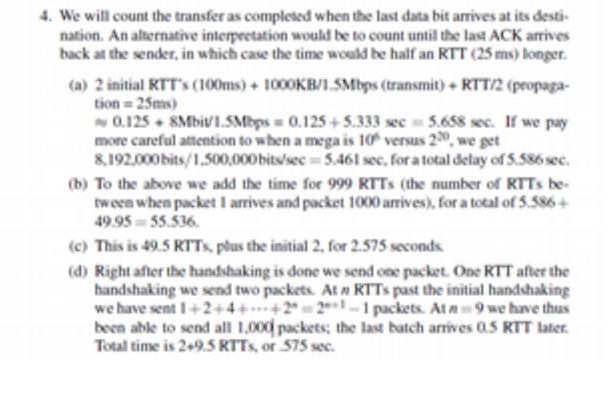
4. We will count the transfer as completed when the last data bit arrives at its desti nation. An alternative interpretation would be to count until the last ACK arrives back at the sender, in which case the time would be half an RTT (25 ms) longer. (a) 2 initial RTT's (100ms) + 1000KB/1 5Mbps (transmit) + RTT/2 (propaga- tion = 25m) 0.125 + 8Mbit/I.5Mops = 0.125 +5.333 sec = 5.658 sec. If we pay more careful attention to when a mega is 10% versus 210, we get 8.192.000 bits/1,500,000 bits/sec = 5,461 sec. for a total delay of 5.586 sec. (b) To the above we add the time for 999 RTTs (the number of RTT's be. tween when packet I arrives and packet 1000 arrives), for a total of 5.586 4 49.95 - 55.536. (c) This is 49.5 RTTs, plus the initial 2, for 2.575 seconds (d) Right after the handshaking is done we send one packet. One RTT after the handshaking we send two packets. At # RTT's past the initial handshaking we have sent 1 +2+4 4...42" = 2"+1- 1 packets. At a = 9 we have thus been able to send all 1.000 packets; the last batch arrives 0.5 RTT later. Total time is 2+9.5 RTTs, or 575 sec
Step by Step Solution
There are 3 Steps involved in it

Get step-by-step solutions from verified subject matter experts
 Study Help