



Question: 4. We've talked a good bit about quantum mice, but we're not done yet. Let's add time dependence to the discussion. We'll work in
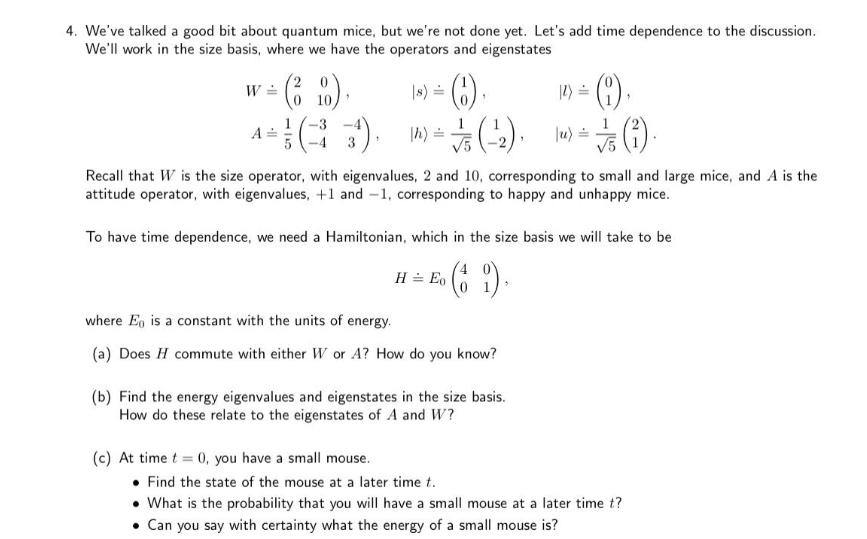
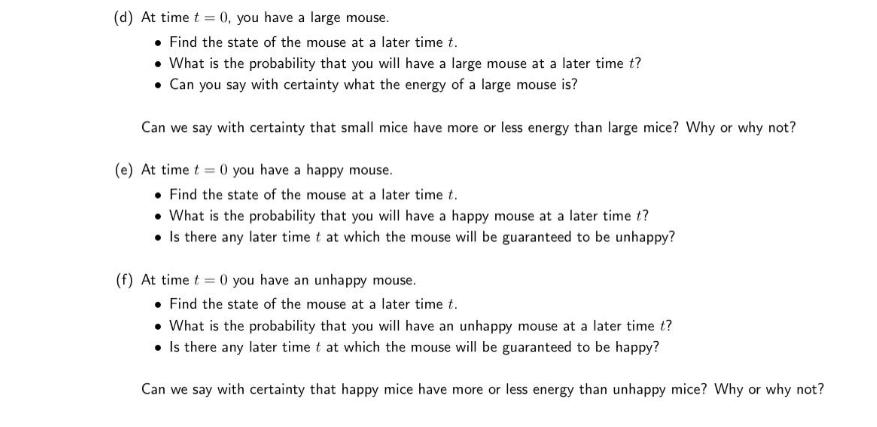
4. We've talked a good bit about quantum mice, but we're not done yet. Let's add time dependence to the discussion. We'll work in the size basis, where we have the operators and eigenstates W = (10), = 1 ( 33), 14) = - A (s) = (66). 1/35 (-2), Recall that W is the size operator, with eigenvalues, 2 and 10, corresponding to small and large mice, and A is the attitude operator, with eigenvalues, +1 and -1, corresponding to happy and unhappy mice. To have time dependence, we need a Hamiltonian, which in the size basis we will take to be (69). H = Eo where Eo is a constant with the units of energy. (a) Does H commute with either W or A? How do you know? (c) At time t = 0, you have a small mouse. (b) Find the energy eigenvalues and eigenstates in the size basis. How do these relate to the eigenstates of A and W? (2)= = (1), (u) = (). Find the state of the mouse at a later time t. What is the probability that you will have a small mouse at a later time t? Can you say with certainty what the energy of a small mouse is? (d) At time t = 0, you have a large mouse. Find the state of the mouse at a later time t. What is the probability that you will have a large mouse at a later time t? Can you say with certainty what the energy of a large mouse is? Can we say with certainty that small mice have more or less energy than large mice? Why or why not? (e) At time t= 0 you have a happy mouse. . Find the state of the mouse at a later time t. What is the probability that you will have a happy mouse at a later time t? Is there any later time t at which the mouse will be guaranteed to be unhappy? (f) At time t = 0) you have an unhappy mouse. Find the state of the mouse at a later time t. What is the probability that you will have an unhappy mouse at a later time t? Is there any later time t at which the mouse will be guaranteed to be happy? Can we say with certainty that happy mice have more or less energy than unhappy mice? Why or why not?
Step by Step Solution
3.28 Rating (154 Votes )
There are 3 Steps involved in it
a To determine whether H commutes with either W or A we need to check if their commutators with H vanish The commutator of two operators X and Y is de... View full answer

Get step-by-step solutions from verified subject matter experts