







Question: 4. When the name of the ionic compound is given, which ion is stated rst? 5. Compare the rst part of the compound name to
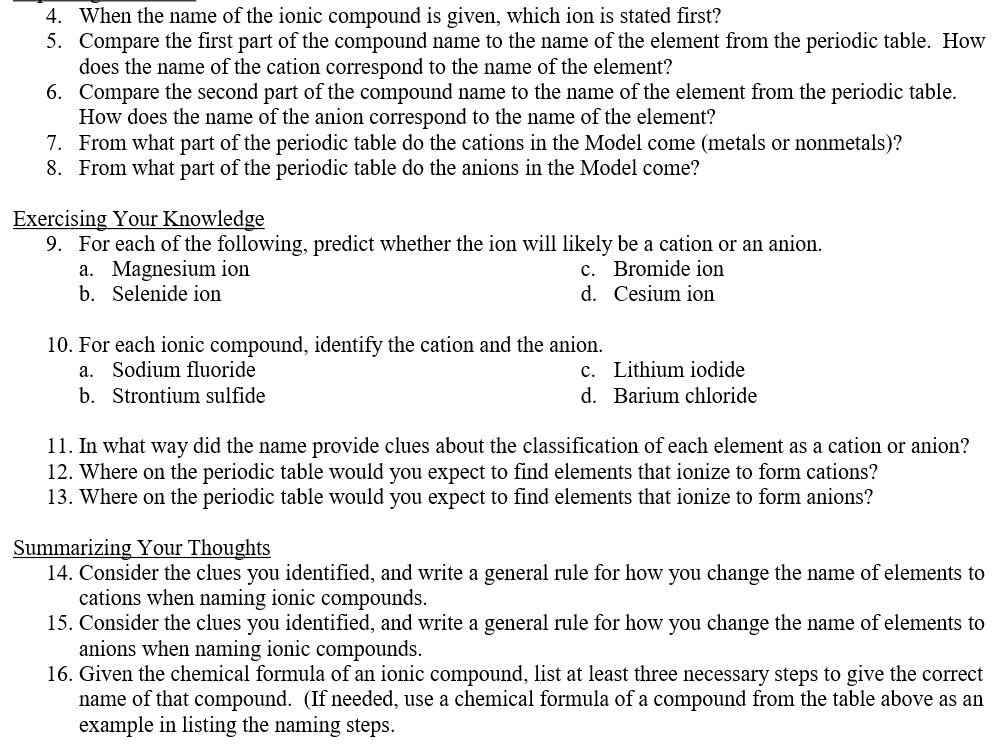
4. When the name of the ionic compound is given, which ion is stated rst? 5. Compare the rst part of the compound name to the name of the element from the periodic table. How does the name of the cation correspond to the name of the element? 6. Compare the second part of the compound name to the name of the element from the periodic table. How does the name of the anion correspond to the name of the element? '1'. From what part of the periodic table do the cations in the Model come (metals or nonmetals)? 8. From what part of the periodic table do the anions in the Model come? Exercising Your Knowledge 9. For each of the following, predict whether the ion will likely he a cation or an anion. a. Magnesium ion c. Bromide ion b. Selenide ion (1. Cesium ion 10. For each ionic compound, identify the cation and the anion. a. Sodium uoride c. Lithium iodide h. Strontium sulde d. Barium chloride 11. In what way did the name provide clues about the classication of each element as a cation or anion? 12. Where on the periodic table would you expect to nd elements that ionize to form cations? 13. Where on the periodic table would you expect to nd elements that ionize to form anions? Summarizing Your Thoughts 14. Consider the clues you identied, and write a general rule for how you change the name of elements to cations when naming ionic compounds. 15. Consider the clues you identied, and write a general rule for how you change the name of elements to anions when naming ionic compounds. 16. Given the chemical formula of an ionic compound, list at least three necessary steps to give the correct name of that compound. (If needed, use a chemical formula of a compound from the table above as an example in listing the naming steps
Step by Step Solution
There are 3 Steps involved in it

Get step-by-step solutions from verified subject matter experts
 Study Help