







Question: 4. You are given the following four training samples, which are subject to principal component analysis. 58 [10] [20] x1 = 3, X2 = 8,X3
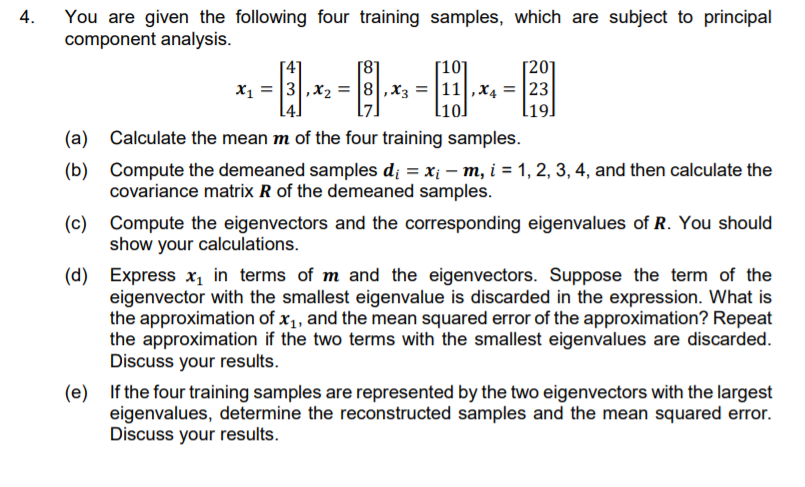
4. You are given the following four training samples, which are subject to principal component analysis. 58 [10] [20] x1 = 3, X2 = 8,X3 = 11,X4 = |23 (10) 119] (a) Calculate the mean m of the four training samples. (b) Compute the demeaned samples di = xi m, i = 1, 2, 3, 4, and then calculate the covariance matrix R of the demeaned samples. (c) Compute the eigenvectors and the corresponding eigenvalues of R. You should show your calculations. (d) Express x, in terms of m and the eigenvectors. Suppose the term of the eigenvector with the smallest eigenvalue is discarded in the expression. What is the approximation of x1, and the mean squared error of the approximation? Repeat the approximation if the two terms with the smallest eigenvalues are discarded. Discuss your results. (e) If the four training samples are represented by the two eigenvectors with the largest eigenvalues, determine the reconstructed samples and the mean squared error. Discuss your results. 4. You are given the following four training samples, which are subject to principal component analysis. 58 [10] [20] x1 = 3, X2 = 8,X3 = 11,X4 = |23 (10) 119] (a) Calculate the mean m of the four training samples. (b) Compute the demeaned samples di = xi m, i = 1, 2, 3, 4, and then calculate the covariance matrix R of the demeaned samples. (c) Compute the eigenvectors and the corresponding eigenvalues of R. You should show your calculations. (d) Express x, in terms of m and the eigenvectors. Suppose the term of the eigenvector with the smallest eigenvalue is discarded in the expression. What is the approximation of x1, and the mean squared error of the approximation? Repeat the approximation if the two terms with the smallest eigenvalues are discarded. Discuss your results. (e) If the four training samples are represented by the two eigenvectors with the largest eigenvalues, determine the reconstructed samples and the mean squared error. Discuss your results
Step by Step Solution
There are 3 Steps involved in it

Get step-by-step solutions from verified subject matter experts
 Study Help