







Question: (40 marks) In the Heckscher-Ohlin-Samuelson Model, two goods (1 and 2) are produced using two factors of production (L and K). The outputs of the
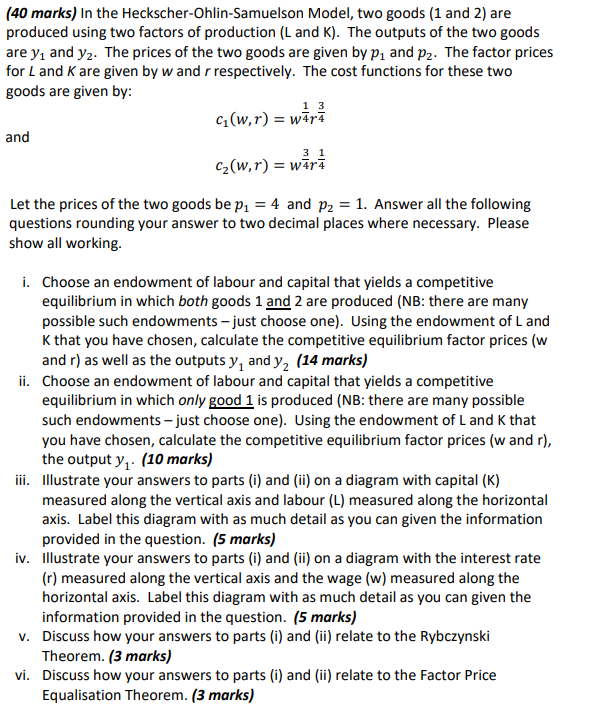
(40 marks) In the Heckscher-Ohlin-Samuelson Model, two goods (1 and 2) are produced using two factors of production (L and K). The outputs of the two goods are y1 and y2. The prices of the two goods are given by p, and p2. The factor prices for L and K are given by w and r respectively. The cost functions for these two goods are given by: 13 1(w, r) = war4 and 31 Cz (w, r) = war4 Let the prices of the two goods be p, = 4 and p2 = 1. Answer all the following questions rounding your answer to two decimal places where necessary. Please show all working. i. Choose an endowment of labour and capital that yields a competitive equilibrium in which both goods 1 and 2 are produced (NB: there are many possible such endowments - just choose one). Using the endowment of Land K that you have chosen, calculate the competitive equilibrium factor prices (w and r) as well as the outputs y, and y2 (14 marks) ii. Choose an endowment of labour and capital that yields a competitive equilibrium in which only good 1 is produced (NB: there are many possible such endowments - just choose one). Using the endowment of L and K that you have chosen, calculate the competitive equilibrium factor prices (w and r), the output y, . (10 marks) iii. Illustrate your answers to parts (i) and (ii) on a diagram with capital (K) measured along the vertical axis and labour (L) measured along the horizontal axis. Label this diagram with as much detail as you can given the information provided in the question. (5 marks) iv. Illustrate your answers to parts (i) and (ii) on a diagram with the interest rate (r) measured along the vertical axis and the wage (w) measured along the horizontal axis. Label this diagram with as much detail as you can given the information provided in the question. (5 marks) v. Discuss how your answers to parts (i) and (ii) relate to the Rybczynski Theorem. (3 marks) vi. Discuss how your answers to parts (i) and (ii) relate to the Factor Price Equalisation Theorem
Step by Step Solution
There are 3 Steps involved in it

Get step-by-step solutions from verified subject matter experts
 Study Help