







Question: (40 points) Design database for university database ER model. The major characteristics of the university: The university is organized into departments. Each department is identified
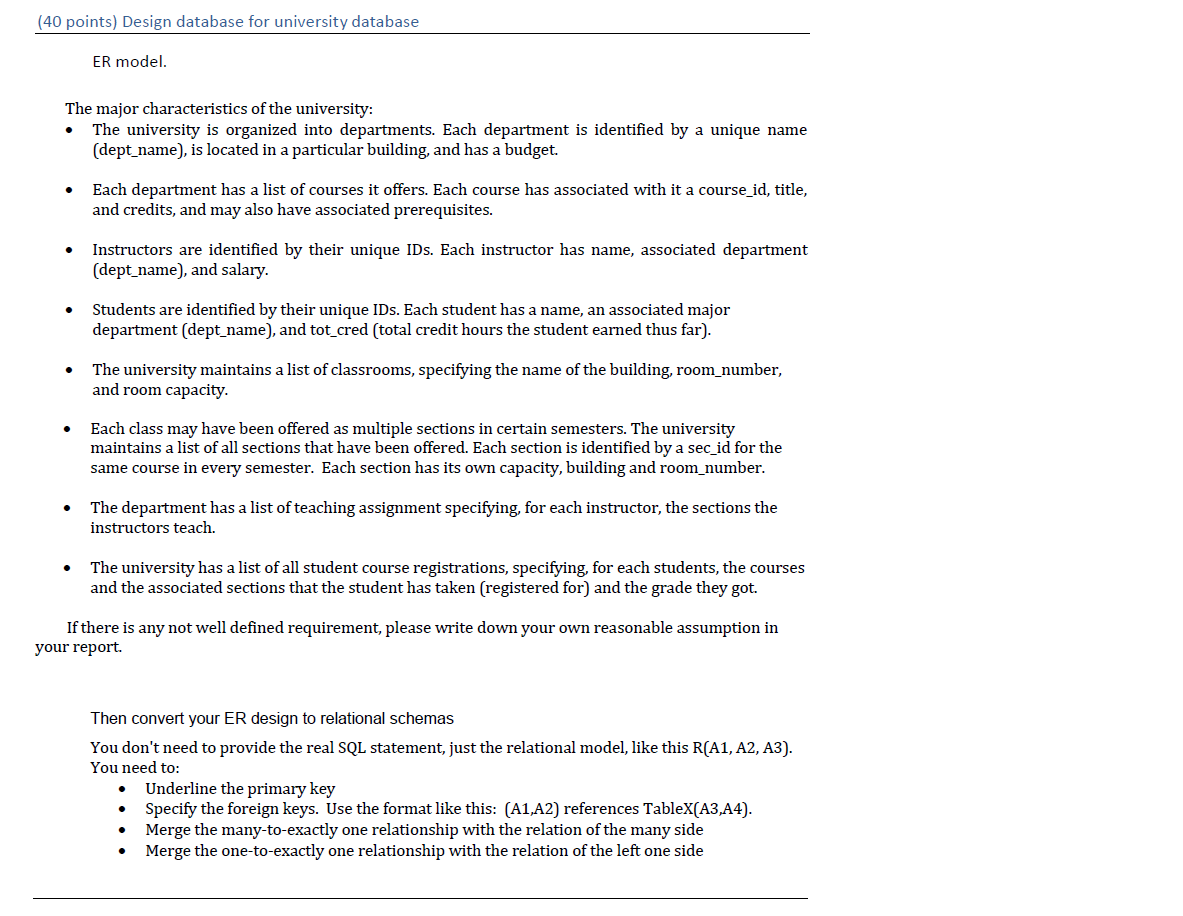
(40 points) Design database for university database ER model. The major characteristics of the university: The university is organized into departments. Each department is identified by a unique name (dept_name), is located in a particular building, and has a budget. Each department has a list of courses it offers. Each course has associated with it a course_id, title, and credits, and may also have associated prerequisites. Instructors are identified by their unique IDs. Each instructor has name, associated department (dept_name), and salary. Students are identified by their unique IDs. Each student has a name, an associated major department (dept_name), and tot_cred (total credit hours the student earned thus far). The university maintains a list of classrooms, specifying the name of the building, room_number, and room capacity. Each class may have been offered as multiple sections in certain semesters. The university maintains a list of all sections that have been offered. Each section is identified by a sec_id for the same course in every semester. Each section has its own capacity, building and room_number. . The department has a list of teaching assignment specifying, for each instructor, the sections the instructors teach. The university has a list of all student course registrations, specifying, for each students, the courses and the associated sections that the student has taken (registered for) and the grade they got. If there is any not well defined requirement, please write down your own reasonable assumption in your report Then convert your ER design to relational schemas You don't need to provide the real SQL statement, just the relational model, like this R(A1, A2, A3). You need to: Underline the primary key Specify the foreign keys. Use the format like this: (A1,A2) references TableX(A3,A4). Merge the many-to-exactly one relationship with the relation of the many side Merge the one-to-exactly one relationship with the relation of the left one side
Step by Step Solution
There are 3 Steps involved in it

Get step-by-step solutions from verified subject matter experts
 Study Help