







Question: 403 ( 7T 47 km = = 1. The 1D Quantum Harmonic Oscillator ('QHO') The first three wavefunctions of the 1D Quantum Harmonic Oscillator are:
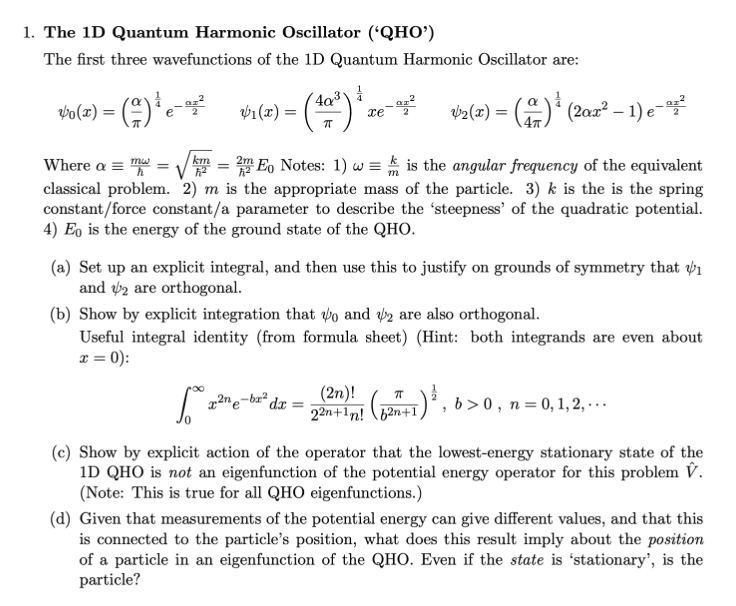

403 ( 7T 47 km = = 1. The 1D Quantum Harmonic Oscillator ('QHO') The first three wavefunctions of the 1D Quantum Harmonic Oscillator are: 1 Po 30(z) = (%) *(a) = V1x) 42(x) = ( ) * (20x - 1) e*** Where a = m = V pont 2n Em Notes: 1) w = is the angular frequency of the equivalent En classical problem. 2) m is the appropriate mass of the particle. 3) k is the is the spring constant/force constant/a parameter to describe the steepness' of the quadratic potential. 4) E, is the energy of the ground state of the QHO. (a) Set up an explicit integral, and then use this to justify on grounds of symmetry that Vi and U2 are orthogonal. (b) Show by explicit integration that vo and 2 are also orthogonal. Useful integral identity (from formula sheet) (Hint: both integrands are even about x = 0): 2276e-br dx (2n)! 22n+1n! +1) , >0, n= 0,1,2,... 62n+1 7T 69 (e) Show by explicit action of the operator that the lowest-energy stationary state of the ID QHO is not an eigenfunction of the potential energy operator for this problem . (Note: This is true for all QHO eigenfunctions.) (a) Given that measurements of the potential energy can give different values, and that this is connected to the particle's position, what does this result imply about the position of a particle in an eigenfunction of the QHO. Even if the state is 'stationary', is the particle? a (e) The interaction energy between atoms in a molecule is modeled by the harmonic potential energy. Explain why this model is unphysical at large displacements
Step by Step Solution
There are 3 Steps involved in it

Get step-by-step solutions from verified subject matter experts
 Study Help