







Question: 41. A perfect number is a positive integer greater than 1 that is equal to the sum of its proper divisors. The smallest perfect number
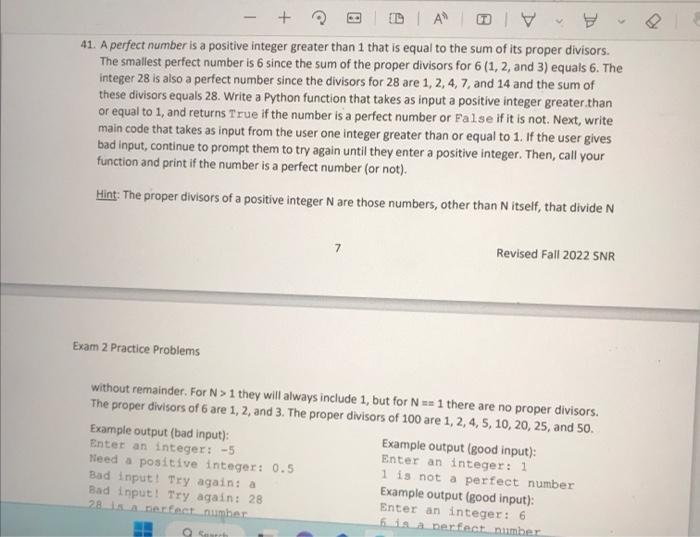
41. A perfect number is a positive integer greater than 1 that is equal to the sum of its proper divisors. The smallest perfect number is 6 since the sum of the proper divisors for 6(1,2, and 3) equals 6 . The integer 28 is also a perfect number since the divisors for 28 are 1,2,4,7, and 14 and the sum of these divisors equals 28. Write a Python function that takes as input a positive integer greater than or equal to 1 , and returns T rue if the number is a perfect number or False if it is not. Next, write main code that takes as input from the user one integer greater than or equal to 1 . If the user gives bad input, continue to prompt them to try again until they enter a positive integer. Then, call your function and print if the number is a perfect number (or not). Hint: The proper divisors of a positive integer N are those numbers, other than N itself, that divide N 7 Revised Fall 2022 SNR Exam 2 Practice Problems without remainder. For N>1 they will always include 1 , but for N=1 there are no proper divisors. The proper divisors of 6 are 1,2 , and 3. The proper divisors of 100 are 1,2,4.5.10. on ac and ra
Step by Step Solution
There are 3 Steps involved in it

Get step-by-step solutions from verified subject matter experts
 Study Help