



Question: 4-4. Linear ramp potential, revisited. Section 4.3.2 introduced the linear ramp potential, (x) = bx. For this problem, consider the case of L = 5
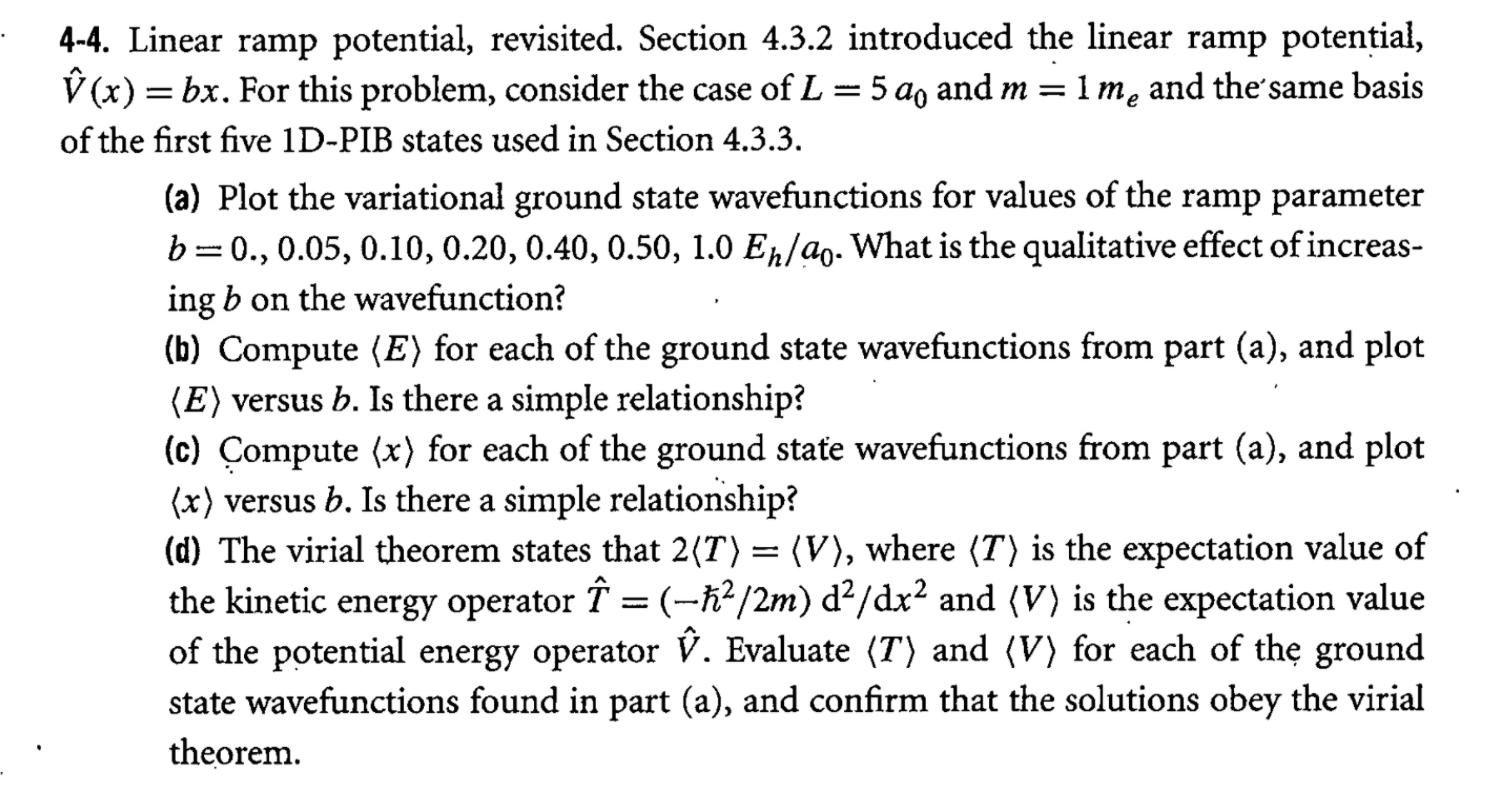
4-4. Linear ramp potential, revisited. Section 4.3.2 introduced the linear ramp potential, (x) = bx. For this problem, consider the case of L = 5 do and m= = 1 me and the same basis of the first five 1D-PIB states used in Section 4.3.3. (a) Plot the variational ground state wavefunctions for values of the ramp parameter b=0., 0.05, 0.10,0.20, 0.40, 0.50, 1.0 En/ao. What is the qualitative effect of increas- ing b on the wavefunction? (b) Compute (E) for each of the ground state wavefunctions from part (a), and plot (E) versus b. Is there a simple relationship? (c) Compute (x) for each of the ground state wavefunctions from part (a), and plot (x) versus b. Is there a simple relationship? (d) The virial theorem states that 2(T) = (V), where (T) is the expectation value of the kinetic energy operator = (-2/2m) d?/dx2 and (V) is the expectation value of the potential energy operator . Evaluate (T) and (V) for each of the ground state wavefunctions found in part (a), and confirm that the solutions obey the virial theorem. = 4-4. Linear ramp potential, revisited. Section 4.3.2 introduced the linear ramp potential, (x) = bx. For this problem, consider the case of L = 5 do and m= = 1 me and the same basis of the first five 1D-PIB states used in Section 4.3.3. (a) Plot the variational ground state wavefunctions for values of the ramp parameter b=0., 0.05, 0.10,0.20, 0.40, 0.50, 1.0 En/ao. What is the qualitative effect of increas- ing b on the wavefunction? (b) Compute (E) for each of the ground state wavefunctions from part (a), and plot (E) versus b. Is there a simple relationship? (c) Compute (x) for each of the ground state wavefunctions from part (a), and plot (x) versus b. Is there a simple relationship? (d) The virial theorem states that 2(T) = (V), where (T) is the expectation value of the kinetic energy operator = (-2/2m) d?/dx2 and (V) is the expectation value of the potential energy operator . Evaluate (T) and (V) for each of the ground state wavefunctions found in part (a), and confirm that the solutions obey the virial theorem. =
Step by Step Solution
There are 3 Steps involved in it

Get step-by-step solutions from verified subject matter experts