





Question: 4.4 Part D (15 Marks) Objectives: To study and simulate the effect of a linear filter on a wave. The effect of a linear filter
4.4 Part D (15 Marks) Objectives: To study and
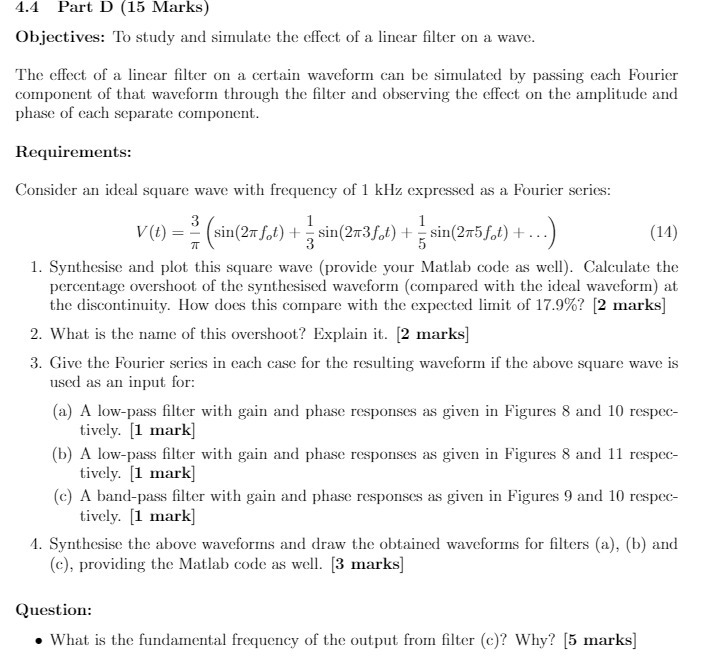
4.4 Part D (15 Marks) Objectives: To study and simulate the effect of a linear filter on a wave. The effect of a linear filter on a certain waveform can be simulated by passing each Fourier component of that waveform through the filter and observing the effect on the amplitude and phase of each separate component. Requirements: Consider an ideal square wave with frequency of 1 kHz expressed as a Fourier series: v(t) = (sin(2x fot) + - sin(273fot) + =sin(2n5fat) + ...) (14) 1. Synthesise and plot this square wave (provide your Matlab code as well). Calculate the percentage overshoot of the synthesised waveform (compared with the ideal waveform) at the discontinuity. How does this compare with the expected limit of 17.9%? [2 marks] 2. What is the name of this overshoot? Explain it. [2 marks] 3. Give the Fourier series in each case for the resulting waveform if the above square wave is used as an input for: (a) A low-pass filter with gain and phase responses as given in Figures 8 and 10 respec- tively. [1 mark] (b) A low-pass filter with gain and phase responses as given in Figures 8 and 11 respec- tively. [1 mark] (c) A band-pass filter with gain and phase responses as given in Figures 9 and 10 respec- tively. [1 mark] 4. Synthesise the above waveforms and draw the obtained waveforms for filters (a), (b) and (c), providing the Matlab code as well. [3 marks] Question: . What is the fundamental frequency of the output from filter (c)? Why? [5 marks]

Step by Step Solution

There are 3 Steps involved in it

1 Expert Approved Answer
Step: 1 Unlock blur-text-image

Question Has Been Solved by an Expert!

Get step-by-step solutions from verified subject matter experts

Step: 2 Unlock
Step: 3 Unlock

Students Have Also Explored These Related Mathematics Questions!