







Question: 4.49 Behboodian (1990) illustrates how to construct bivariate random variables that are uncorrelated but dependent. Suppose that f1, f2, 91, 92 are univariate densities
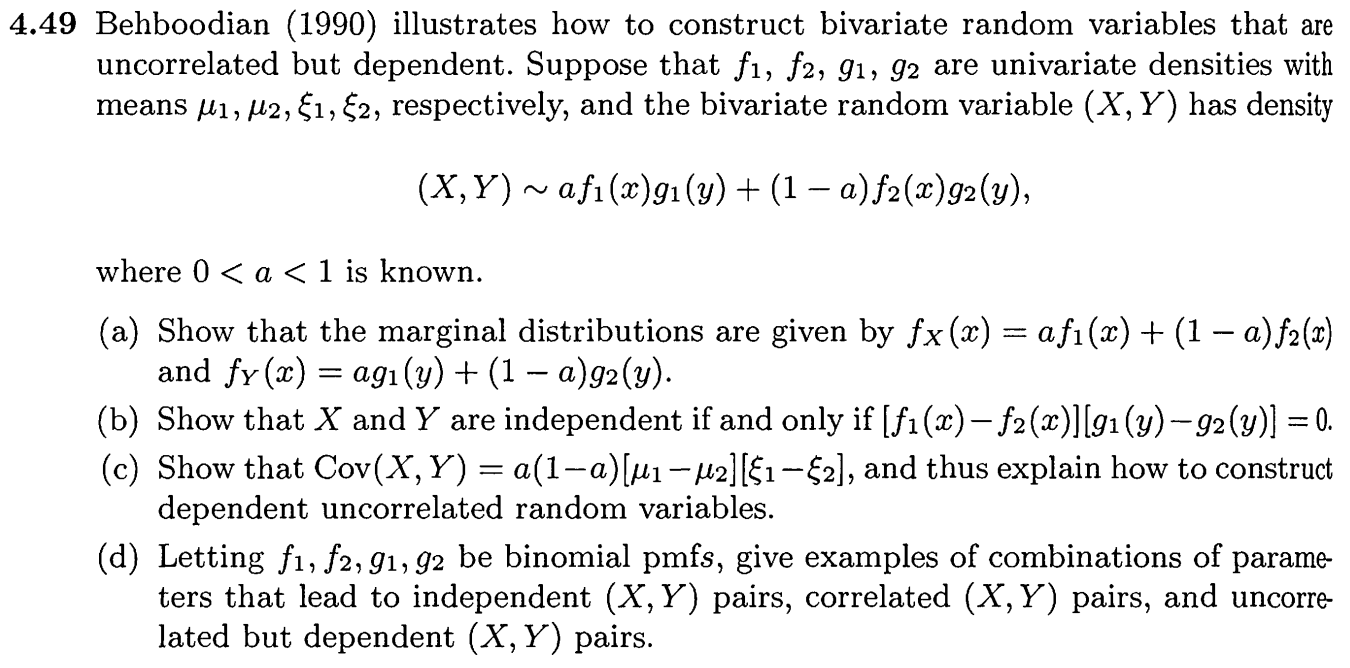
4.49 Behboodian (1990) illustrates how to construct bivariate random variables that are uncorrelated but dependent. Suppose that f1, f2, 91, 92 are univariate densities with means , 2, 1, 2, respectively, and the bivariate random variable (X, Y) has density (X,Y) ~ afi(x)g(y) + (1 a) f2(x)g2 (y), where 0 < a < 1 is known. (a) Show that the marginal distributions are given by x(x) = a(x) + (1 a) 2(x) and fy(x) = ag (y) + (1 a)92(y). - (b) Show that X and Y are independent if and only if [1 (x) 2(x)][91(y) 92(y)] = 0. (c) Show that Cov(X, Y) = a(1a)[1 2][12], and thus explain how to construct dependent uncorrelated random variables. (d) Letting f1, f2, 91, 92 be binomial pmfs, give examples of combinations of parame- ters that lead to independent (X, Y) pairs, correlated (X, Y) pairs, and uncorre- lated but dependent (X, Y) pairs.
Step by Step Solution
3.40 Rating (153 Votes )
There are 3 Steps involved in it
a To show that the marginal distributions are given by fXx af1x 1 af2x and fYy ag1y 1 ag2y we need to calculate the marginal densities Marginal density of X fXx To find the marginal density of X we in... View full answer

Get step-by-step solutions from verified subject matter experts
 Study Help