







Question: 45 We use the following artificial data to illustrate comments in Section 4.5.3 about grouped versus ungrouped binary data: Number of trials Number of successes
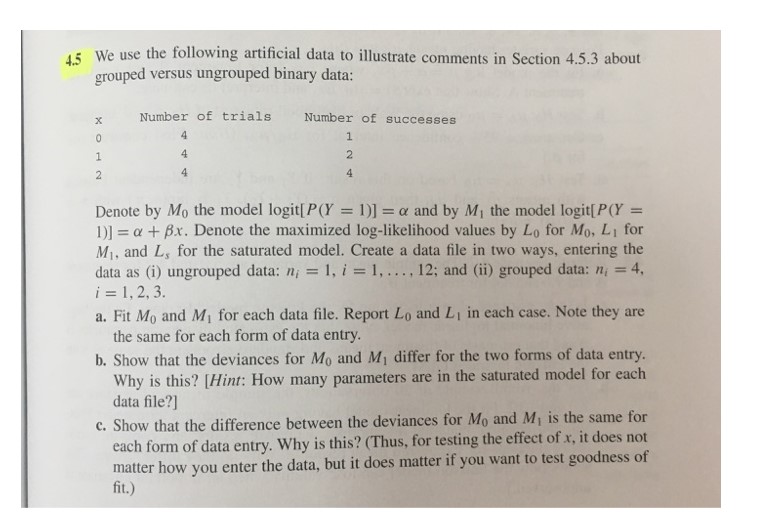
45 We use the following artificial data to illustrate comments in Section 4.5.3 about grouped versus ungrouped binary data: Number of trials Number of successes 1 NJ Denote by Mo the model logit[P(Y = 1)] = o and by M, the model logit[ P(Y = 1)] = a + B.x. Denote the maximized log-likelihood values by Lo for Mo, L, for M1, and L, for the saturated model. Create a data file in two ways, entering the data as (i) ungrouped data: n; = 1, i = 1, . .., 12; and (ii) grouped data: n, = 4, i = 1, 2, 3. a. Fit Mo and M, for each data file. Report Lo and L, in each case. Note they are the same for each form of data entry. b. Show that the deviances for Mo and M, differ for the two forms of data entry. Why is this? [Hint: How many parameters are in the saturated model for each data file?] C. Show that the difference between the deviances for Mo and M, is the same for each form of data entry. Why is this? (Thus, for testing the effect of x, it does not matter how you enter the data, but it does matter if you want to test goodness of fit.)
Step by Step Solution
There are 3 Steps involved in it

Get step-by-step solutions from verified subject matter experts
 Study Help