







Question: 46 A school district must determine which students from each of the four attendance zones will attend which of the three high schools. The north
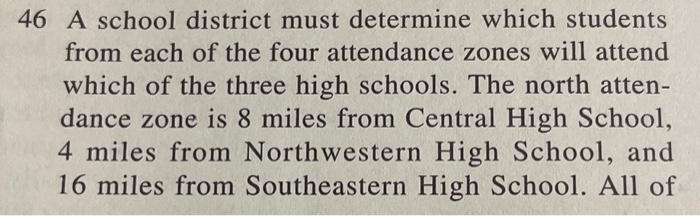
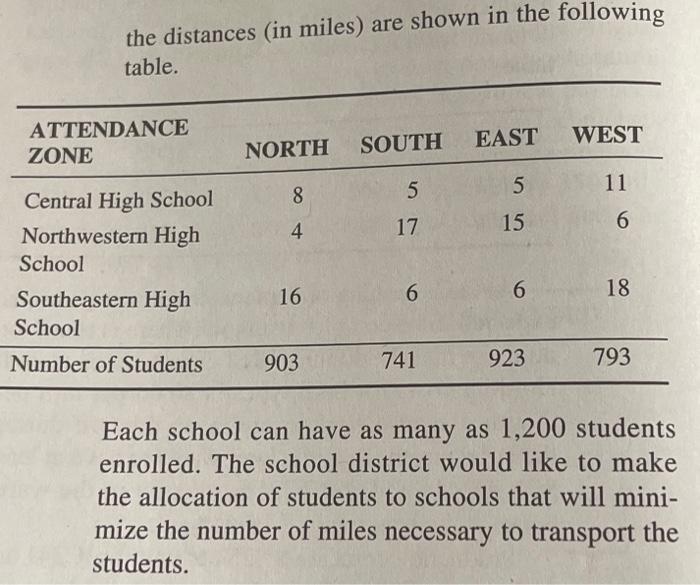
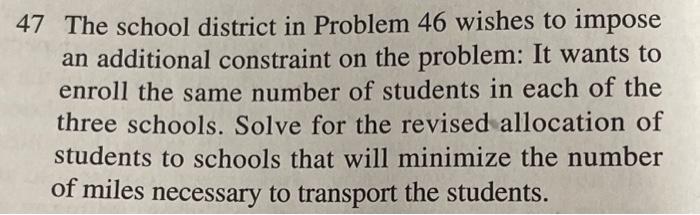
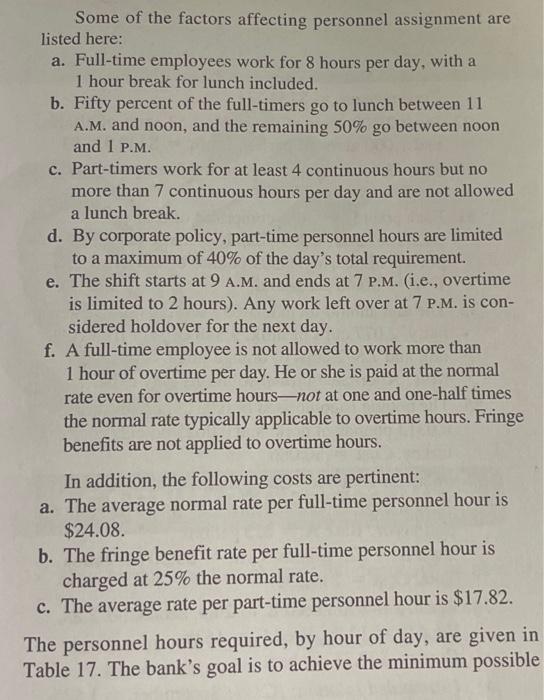
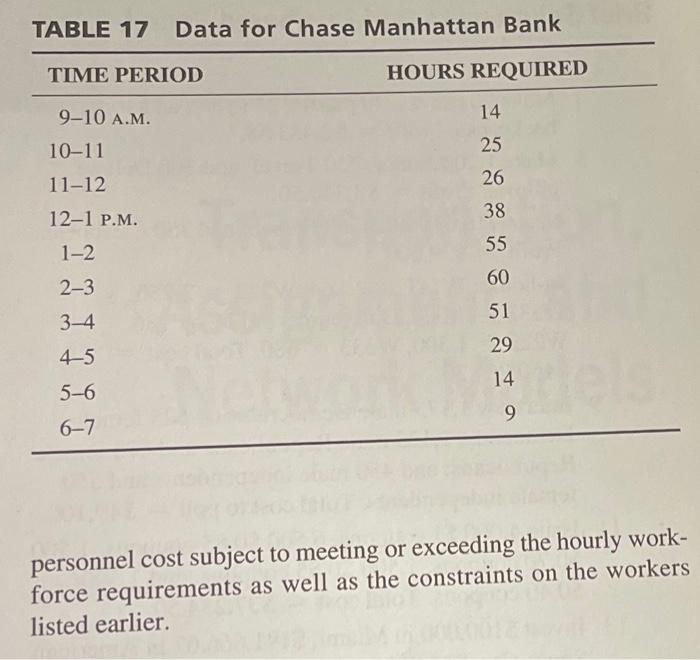
46 A school district must determine which students from each of the four attendance zones will attend which of the three high schools. The north attendance zone is 8 miles from Central High School, 4 miles from Northwestern High School, and 16 miles from Southeastern High School. All of personnel cost subject to meeting or exceeding the hourly workforce requirements as well as the constraints on the workers listed earlier. the distances (in miles) are shown in the following table. Each school can have as many as 1,200 students enrolled. The school district would like to make the allocation of students to schools that will minimize the number of miles necessary to transport the students. 47 The school district in Problem 46 wishes to impose an additional constraint on the problem: It wants to enroll the same number of students in each of the three schools. Solve for the revised allocation of students to schools that will minimize the number of miles necessary to transport the students. Some of the factors affecting personnel assignment are listed here: a. Full-time employees work for 8 hours per day, with a 1 hour break for lunch included. b. Fifty percent of the full-timers go to lunch between 11 A.M. and noon, and the remaining 50% go between noon and 1 P.M. c. Part-timers work for at least 4 continuous hours but no more than 7 continuous hours per day and are not allowed a lunch break. d. By corporate policy, part-time personnel hours are limited to a maximum of 40% of the day's total requirement. e. The shift starts at 9 A.M. and ends at 7 P.M. (i.e., overtime is limited to 2 hours). Any work left over at 7 P.M. is considered holdover for the next day. f. A full-time employee is not allowed to work more than 1 hour of overtime per day. He or she is paid at the normal rate even for overtime hours - not at one and one-half times the normal rate typically applicable to overtime hours. Fringe benefits are not applied to overtime hours. In addition, the following costs are pertinent: a. The average normal rate per full-time personnel hour is $24.08. b. The fringe benefit rate per full-time personnel hour is charged at 25% the normal rate. c. The average rate per part-time personnel hour is $17.82. The personnel hours required, by hour of day, are given in Table 17. The bank's goal is to achieve the minimum possible 46 A school district must determine which students from each of the four attendance zones will attend which of the three high schools. The north attendance zone is 8 miles from Central High School, 4 miles from Northwestern High School, and 16 miles from Southeastern High School. All of personnel cost subject to meeting or exceeding the hourly workforce requirements as well as the constraints on the workers listed earlier. the distances (in miles) are shown in the following table. Each school can have as many as 1,200 students enrolled. The school district would like to make the allocation of students to schools that will minimize the number of miles necessary to transport the students. 47 The school district in Problem 46 wishes to impose an additional constraint on the problem: It wants to enroll the same number of students in each of the three schools. Solve for the revised allocation of students to schools that will minimize the number of miles necessary to transport the students. Some of the factors affecting personnel assignment are listed here: a. Full-time employees work for 8 hours per day, with a 1 hour break for lunch included. b. Fifty percent of the full-timers go to lunch between 11 A.M. and noon, and the remaining 50% go between noon and 1 P.M. c. Part-timers work for at least 4 continuous hours but no more than 7 continuous hours per day and are not allowed a lunch break. d. By corporate policy, part-time personnel hours are limited to a maximum of 40% of the day's total requirement. e. The shift starts at 9 A.M. and ends at 7 P.M. (i.e., overtime is limited to 2 hours). Any work left over at 7 P.M. is considered holdover for the next day. f. A full-time employee is not allowed to work more than 1 hour of overtime per day. He or she is paid at the normal rate even for overtime hours - not at one and one-half times the normal rate typically applicable to overtime hours. Fringe benefits are not applied to overtime hours. In addition, the following costs are pertinent: a. The average normal rate per full-time personnel hour is $24.08. b. The fringe benefit rate per full-time personnel hour is charged at 25% the normal rate. c. The average rate per part-time personnel hour is $17.82. The personnel hours required, by hour of day, are given in Table 17. The bank's goal is to achieve the minimum possible
Step by Step Solution
There are 3 Steps involved in it

Get step-by-step solutions from verified subject matter experts
 Study Help