



Question: 4.6 A stirred-tank blending system can be described by a first-order transfer function between the exit composition x and the inlet composition x1 (both are
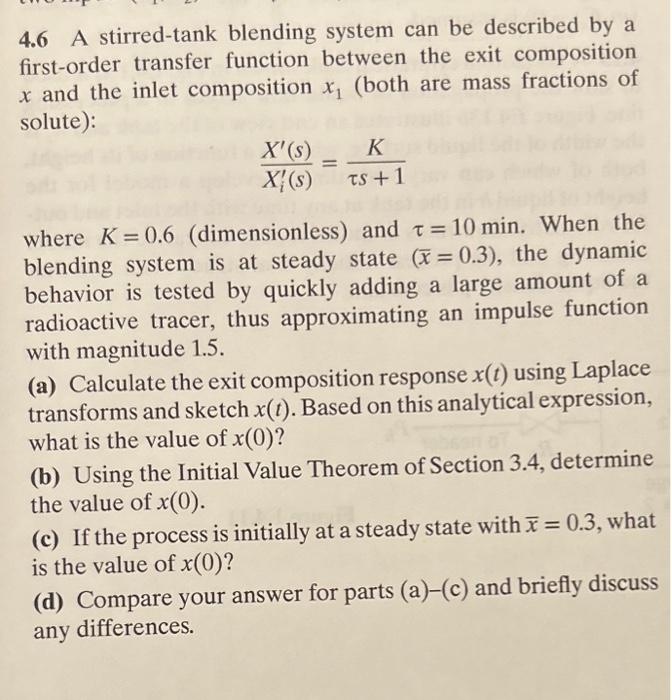
4.6 A stirred-tank blending system can be described by a first-order transfer function between the exit composition x and the inlet composition x1 (both are mass fractions of solute): Xi(s)X(s)=s+1K where K=0.6 (dimensionless) and =10min. When the blending system is at steady state (x=0.3), the dynamic behavior is tested by quickly adding a large amount of a radioactive tracer, thus approximating an impulse function with magnitude 1.5. (a) Calculate the exit composition response x(t) using Laplace transforms and sketch x(t). Based on this analytical expression, what is the value of x(0) ? (b) Using the Initial Value Theorem of Section 3.4, determine the value of x(0). (c) If the process is initially at a steady state with x=0.3, what is the value of x(0) ? (d) Compare your answer for parts (a)-(c) and briefly discuss any differences. 4.6 A stirred-tank blending system can be described by a first-order transfer function between the exit composition x and the inlet composition x1 (both are mass fractions of solute): Xi(s)X(s)=s+1K where K=0.6 (dimensionless) and =10min. When the blending system is at steady state (x=0.3), the dynamic behavior is tested by quickly adding a large amount of a radioactive tracer, thus approximating an impulse function with magnitude 1.5. (a) Calculate the exit composition response x(t) using Laplace transforms and sketch x(t). Based on this analytical expression, what is the value of x(0) ? (b) Using the Initial Value Theorem of Section 3.4, determine the value of x(0). (c) If the process is initially at a steady state with x=0.3, what is the value of x(0) ? (d) Compare your answer for parts (a)-(c) and briefly discuss any differences
Step by Step Solution
There are 3 Steps involved in it

Get step-by-step solutions from verified subject matter experts