



Question: 4.6. This problem illustrates that a set of custom coefficients is maximally sensitive to the hypothesized pattern of means on which the set is based.
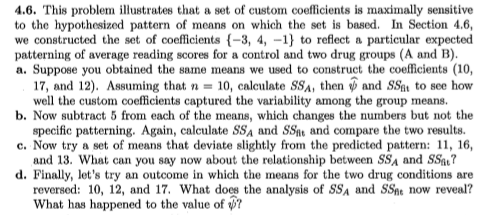
4.6. This problem illustrates that a set of custom coefficients is maximally sensitive to the hypothesized pattern of means on which the set is based. In Section 4.6, we constructed the set of coefficients (-3, 4, -1} to reflect a particular expected patterning of average reading scores for a control and two drug groups (A and B). a. Suppose you obtained the same means we used to construct the coefficients (10, 17, and 12). Assuming that n = 10, calculate SSA, then and Set to see how well the custom coefficients captured the variability among the group means. b. Now subtract 5 from each of the means, which changes the numbers but not the specific patterning. Again, calculate SSA and SSH and compare the two results. c. Now try a set of means that deviate slightly from the predicted pattern: 11, 16, and 13. What can you say now about the relationship between $SA and SSat? d. Finally, let's try an outcome in which the means for the two drug conditions are reversed: 10, 12, and 17. What does the analysis of SSA and SS now reveal? What has happened to the value of ? 4.6. This problem illustrates that a set of custom coefficients is maximally sensitive to the hypothesized pattern of means on which the set is based. In Section 4.6, we constructed the set of coefficients (-3, 4, -1} to reflect a particular expected patterning of average reading scores for a control and two drug groups (A and B). a. Suppose you obtained the same means we used to construct the coefficients (10, 17, and 12). Assuming that n = 10, calculate SSA, then and Set to see how well the custom coefficients captured the variability among the group means. b. Now subtract 5 from each of the means, which changes the numbers but not the specific patterning. Again, calculate SSA and SSH and compare the two results. c. Now try a set of means that deviate slightly from the predicted pattern: 11, 16, and 13. What can you say now about the relationship between $SA and SSat? d. Finally, let's try an outcome in which the means for the two drug conditions are reversed: 10, 12, and 17. What does the analysis of SSA and SS now reveal? What has happened to the value of
Step by Step Solution
There are 3 Steps involved in it

Get step-by-step solutions from verified subject matter experts