







Question: 4.6 We can use the k-NN method for regression. Let D={xi,yi}i=1n be a training set, where the labels yR are generated by y=F(x)+, in which
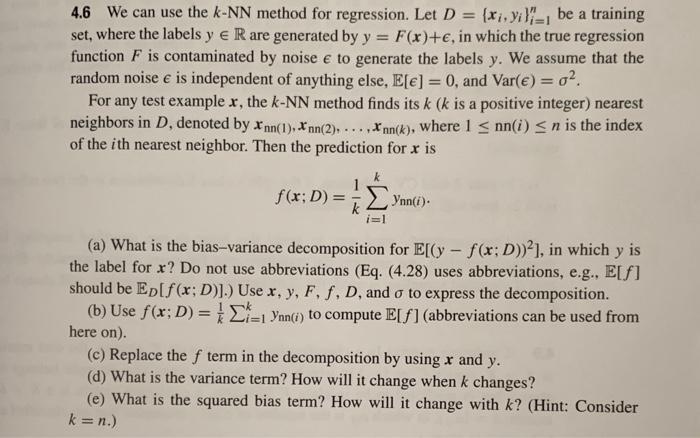
4.6 We can use the k-NN method for regression. Let D={xi,yi}i=1n be a training set, where the labels yR are generated by y=F(x)+, in which the true regression function F is contaminated by noise to generate the labels y. We assume that the random noise is independent of anything else, E[]=0, and Var()=2. For any test example x, the k-NN method finds its k ( k is a positive integer) nearest neighbors in D, denoted by xnn(1),xnn(2),,xnn(k), where 1nn(i)n is the index of the i th nearest neighbor. Then the prediction for x is f(x;D)=k1i=1kynn(i). (a) What is the bias-variance decomposition for E[(yf(x;D))2], in which y is the label for x ? Do not use abbreviations (Eq. (4.28) uses abbreviations, e.g., E[f] should be ED[f(x;D)].) Use x,y,F,f,D, and to express the decomposition. (b) Use f(x;D)=k1i=1kynn(i) to compute E[f] (abbreviations can be used from here on). (c) Replace the f term in the decomposition by using x and y. (d) What is the variance term? How will it change when k changes? (e) What is the squared bias term? How will it change with k ? (Hint: Consider k=n.)
Step by Step Solution
There are 3 Steps involved in it

Get step-by-step solutions from verified subject matter experts
 Study Help