







Question: 4.7 Consider a problem of running three foreground threads using a preemptive scheduler with semaphore synchronization. Each thread has a central body() containing code that
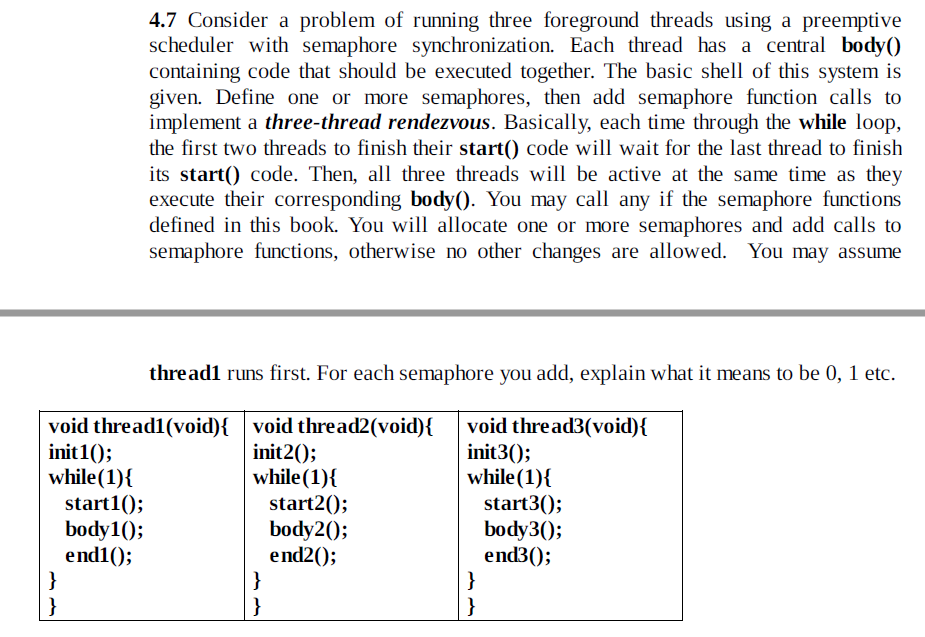
4.7 Consider a problem of running three foreground threads using a preemptive scheduler with semaphore synchronization. Each thread has a central body() containing code that should be executed together. The basic shell of this system is given. Define one or more semaphores, then add semaphore function calls to implement a three-thread rendezvous. Basically, each time through the while loop, the first two threads to finish their start() code will wait for the last thread to finish its start() code. Then, all three threads will be active at the same time as they execute their corresponding body(). You may call any if the semaphore functions defined in this book. You will allocate one or more semaphores and add calls to semaphore functions, otherwise no other changes are allowed. You may assume thread1 runs first. For each semaphore you add, explain what it means to be 0, 1 etc. void threadl(void){ void thread2(void) { init1(); init2(); while(1){ while(1){ start1(); start2(); body1(); body2(); end1(); end2(); } } } } void thread3(void){ init3(); while(1){ start30; body30); end3(); } } 4.7 Consider a problem of running three foreground threads using a preemptive scheduler with semaphore synchronization. Each thread has a central body() containing code that should be executed together. The basic shell of this system is given. Define one or more semaphores, then add semaphore function calls to implement a three-thread rendezvous. Basically, each time through the while loop, the first two threads to finish their start() code will wait for the last thread to finish its start() code. Then, all three threads will be active at the same time as they execute their corresponding body(). You may call any if the semaphore functions defined in this book. You will allocate one or more semaphores and add calls to semaphore functions, otherwise no other changes are allowed. You may assume thread1 runs first. For each semaphore you add, explain what it means to be 0, 1 etc. void threadl(void){ void thread2(void) { init1(); init2(); while(1){ while(1){ start1(); start2(); body1(); body2(); end1(); end2(); } } } } void thread3(void){ init3(); while(1){ start30; body30); end3(); } }
Step by Step Solution
There are 3 Steps involved in it

Get step-by-step solutions from verified subject matter experts
 Study Help