



Question: 4b. In the following fact pattern, please apply the four factors, decide if Mike will be considered a merchant or farmer and if the Merchant's
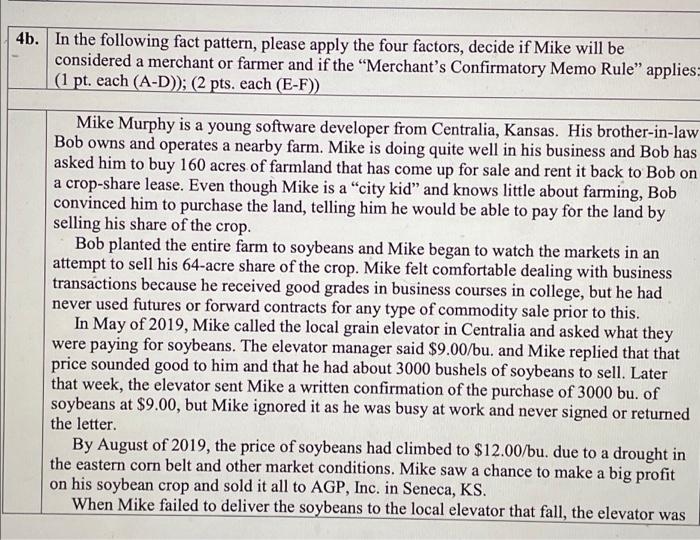
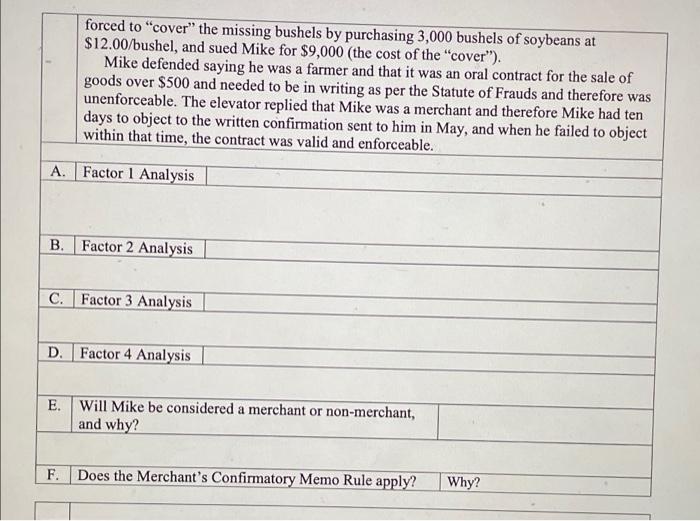
4b. In the following fact pattern, please apply the four factors, decide if Mike will be considered a merchant or farmer and if the "Merchant's Confirmatory Memo Rule applies (1 pt. each (A-D)); (2 pts. each (E-F)) a Mike Murphy is a young software developer from Centralia, Kansas. His brother-in-law Bob owns and operates a nearby farm. Mike is doing quite well in his business and Bob has asked him to buy 160 acres of farmland that has come up for sale and rent it back to Bob on a crop-share lease. Even though Mike is a "city kid" and knows little about farming, Bob convinced him to purchase the land, telling him he would be able to pay for the land by selling his share of the crop. Bob planted the entire farm to soybeans and Mike began to watch the markets in an attempt to sell his 64-acre share of the crop. Mike felt comfortable dealing with business transactions because he received good grades in business courses in college, but he had never used futures or forward contracts for any type of commodity sale prior to this. In May of 2019, Mike called the local grain elevator in Centralia and asked what they were paying for soybeans. The elevator manager said $9.00/bu. and Mike replied that that price sounded good to him and that he had about 3000 bushels of soybeans to sell. Later that week, the elevator sent Mike a written confirmation of the purchase of 3000 bu. of soybeans at $9.00, but Mike ignored it as he was busy at work and never signed or returned the letter. By August of 2019, the price of soybeans had climbed to $12.00/bu. due to a drought in the eastern corn belt and other market conditions. Mike saw a chance to make a big profit on his soybean crop and sold it all to AGP, Inc. in Seneca, KS. When Mike failed to deliver the soybeans to the local elevator that fall, the elevator was a forced to "cover" the missing bushels by purchasing 3,000 bushels of soybeans at $12.00/bushel, and sued Mike for $9,000 (the cost of the "cover"). Mike defended saying he was a farmer and that it was an oral contract for the sale of goods over $500 and needed to be in writing as per the Statute of Frauds and therefore was unenforceable. The elevator replied that Mike was a merchant and therefore Mike had ten days to object to the written confirmation sent to him in May, and when he failed to object within that time, the contract was valid and enforceable. A. Factor 1 Analysis B. Factor 2 Analysis C. Factor 3 Analysis D. Factor 4 Analysis E. Will Mike be considered a merchant or non-merchant, and why? F. Does the Merchant's Confirmatory Memo Rule apply? Why? 4b. In the following fact pattern, please apply the four factors, decide if Mike will be considered a merchant or farmer and if the "Merchant's Confirmatory Memo Rule applies (1 pt. each (A-D)); (2 pts. each (E-F)) a Mike Murphy is a young software developer from Centralia, Kansas. His brother-in-law Bob owns and operates a nearby farm. Mike is doing quite well in his business and Bob has asked him to buy 160 acres of farmland that has come up for sale and rent it back to Bob on a crop-share lease. Even though Mike is a "city kid" and knows little about farming, Bob convinced him to purchase the land, telling him he would be able to pay for the land by selling his share of the crop. Bob planted the entire farm to soybeans and Mike began to watch the markets in an attempt to sell his 64-acre share of the crop. Mike felt comfortable dealing with business transactions because he received good grades in business courses in college, but he had never used futures or forward contracts for any type of commodity sale prior to this. In May of 2019, Mike called the local grain elevator in Centralia and asked what they were paying for soybeans. The elevator manager said $9.00/bu. and Mike replied that that price sounded good to him and that he had about 3000 bushels of soybeans to sell. Later that week, the elevator sent Mike a written confirmation of the purchase of 3000 bu. of soybeans at $9.00, but Mike ignored it as he was busy at work and never signed or returned the letter. By August of 2019, the price of soybeans had climbed to $12.00/bu. due to a drought in the eastern corn belt and other market conditions. Mike saw a chance to make a big profit on his soybean crop and sold it all to AGP, Inc. in Seneca, KS. When Mike failed to deliver the soybeans to the local elevator that fall, the elevator was a forced to "cover" the missing bushels by purchasing 3,000 bushels of soybeans at $12.00/bushel, and sued Mike for $9,000 (the cost of the "cover"). Mike defended saying he was a farmer and that it was an oral contract for the sale of goods over $500 and needed to be in writing as per the Statute of Frauds and therefore was unenforceable. The elevator replied that Mike was a merchant and therefore Mike had ten days to object to the written confirmation sent to him in May, and when he failed to object within that time, the contract was valid and enforceable. A. Factor 1 Analysis B. Factor 2 Analysis C. Factor 3 Analysis D. Factor 4 Analysis E. Will Mike be considered a merchant or non-merchant, and why? F. Does the Merchant's Confirmatory Memo Rule apply? Why
Step by Step Solution
There are 3 Steps involved in it

Get step-by-step solutions from verified subject matter experts