







Question: 4th Practice, June 09 2 Summer Term 22 Problem 3 OFFSHORING - FEENSTRA&HANSON IDEA (6 Points) A firm produces mainframes in the U-country and M-land,
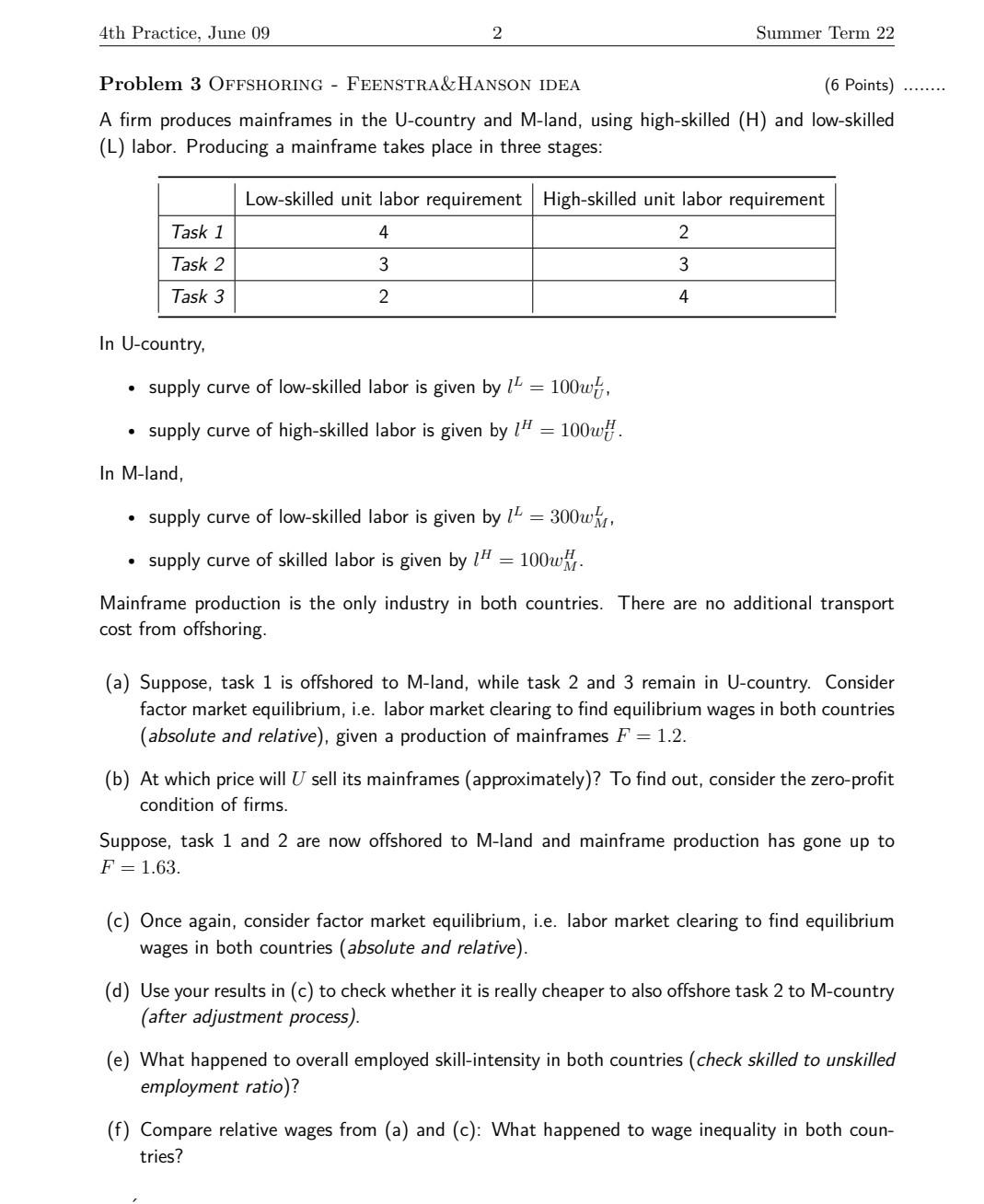
4th Practice, June 09 2 Summer Term 22 Problem 3 OFFSHORING - FEENSTRA&HANSON IDEA (6 Points) A firm produces mainframes in the U-country and M-land, using high-skilled (H) and low-skilled (L) labor. Producing a mainframe takes place in three stages: Low-skilled unit labor requirement High-skilled unit labor requirement Task 1 4 2 Task 2 3 3 Task 3 2 4 In U-country, supply curve of low-skilled labor is given by 1 = 100w, supply curve of high-skilled labor is given by 1H = 100w. In M-land, supply curve of low-skilled labor is given by 1 = 300w, supply curve of skilled labor is given by 1 = 100w. Mainframe production is the only industry in both countries. There are no additional transport cost from offshoring. (a) Suppose, task 1 is offshored to M-land, while task 2 and 3 remain in U-country. Consider factor market equilibrium, i.e. labor market clearing to find equilibrium wages in both countries (absolute and relative), given a production of mainframes F = 1.2. (b) At which price will U sell its mainframes (approximately)? To find out, consider the zero-profit condition of firms. Suppose, task 1 and 2 are now offshored to M-land and mainframe production has gone up to F = 1.63. (c) Once again, consider factor market equilibrium, i.e. labor market clearing to find equilibrium wages in both countries (absolute and relative). (d) Use your results in (c) to check whether it is really cheaper to also offshore task 2 to M-country (after adjustment process). (e) What happened to overall employed skill-intensity in both countries (check skilled to unskilled employment ratio)? (f) Compare relative wages from (a) and (c): What happened to wage inequality in both coun- tries? 4th Practice, June 09 2 Summer Term 22 Problem 3 OFFSHORING - FEENSTRA&HANSON IDEA (6 Points) A firm produces mainframes in the U-country and M-land, using high-skilled (H) and low-skilled (L) labor. Producing a mainframe takes place in three stages: Low-skilled unit labor requirement High-skilled unit labor requirement Task 1 4 2 Task 2 3 3 Task 3 2 4 In U-country, supply curve of low-skilled labor is given by 1 = 100w, supply curve of high-skilled labor is given by 1H = 100w. In M-land, supply curve of low-skilled labor is given by 1 = 300w, supply curve of skilled labor is given by 1 = 100w. Mainframe production is the only industry in both countries. There are no additional transport cost from offshoring. (a) Suppose, task 1 is offshored to M-land, while task 2 and 3 remain in U-country. Consider factor market equilibrium, i.e. labor market clearing to find equilibrium wages in both countries (absolute and relative), given a production of mainframes F = 1.2. (b) At which price will U sell its mainframes (approximately)? To find out, consider the zero-profit condition of firms. Suppose, task 1 and 2 are now offshored to M-land and mainframe production has gone up to F = 1.63. (c) Once again, consider factor market equilibrium, i.e. labor market clearing to find equilibrium wages in both countries (absolute and relative). (d) Use your results in (c) to check whether it is really cheaper to also offshore task 2 to M-country (after adjustment process). (e) What happened to overall employed skill-intensity in both countries (check skilled to unskilled employment ratio)? (f) Compare relative wages from (a) and (c): What happened to wage inequality in both coun- tries
Step by Step Solution
There are 3 Steps involved in it

Get step-by-step solutions from verified subject matter experts
 Study Help