







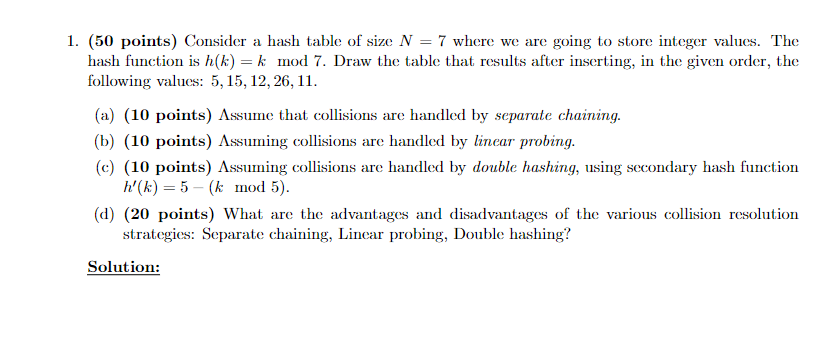
Question: ( 5 0 points ) Consider a hash table of size N = 7 where we are going to store integer values. The hash function
points Consider a hash table of size where we are going to store integer values. The
hash function is mod Draw the table that results after inserting, in the given order, the
following values:
a points Assume that collisions are handled by separate chaining.
b points Assuming collisions are handled by linear probing.
c points Assuming collisions are handled by double hashing, using secondary hash function
d points What are the advantages and disadvantages of the various collision resolution
strategies: Separate chaining, Lincar probing, Double hashing?
Solution: points
a points What is the preorder traversal of the following binary tree?
b points What is the inorder traversal of the above binary tree?
c points What is the postorder traversal of the above binary tree?
Solution: points Consider the following binary max heap ie the arrayrepresentation of a heapordered
complete binary tree Here assume
Delete the maximum key. Give the resulting binary heap. Circle those values that changed.
Insert the key into the original binary heap. Give the resulting binary heap. Circle those
values that changed.
Solution:
Step by Step Solution
There are 3 Steps involved in it
1 Expert Approved Answer
Step: 1 Unlock

Question Has Been Solved by an Expert!
Get step-by-step solutions from verified subject matter experts
Step: 2 Unlock
Step: 3 Unlock
 Study Help