







Question: ( 5 0 pts . ) Please write a material balance problem for a multiple - unit process without reaction involving three ( 5 0
pts Please write a material balance problem for a multipleunit process without reaction involving three pts Please write and solve a combustion reaction problem in which three fuel materials are combusted. You
must provide a process specification for oxygen or air being fed in excess. At least one of the three fuels must
undergo both complete and incomplete combustion, and at least one of the fuels must not be fully consumed. A
value for the input flow rate of the fuel stream should be provided in the problem statement. The input flow rate of
the airoxygen stream cannot be specified. The problem solution must determine the molar flow rate of the product
stream and its composition on both a wet basis and a dry basis. The solution should show that the process has
exactly zero degrees of freedom. Material balances must be in the form of either atomic species balances or extent
of reaction equations. A completely labeled flow diagram should be part of the solution.
Both a typed or handwritten solution and an Excel summary should be provided for the problem. The typed or
handwritten solution should include a list of all equations a written based on the flow diagram before beginning to
solve, followed by the appropriate solution steps. The template and instructions for the Excel summary are provided
below.
Options for reactants to be combusted choose :
Hydrogen Methane Ethane Propane Butane Pentane Hexane
Heptane Octane
Excel Summary format for Questions and :
Your Excel summary should be provided in the format shown below. List the names of your unknown variables in Column
A List the corresponding solved numerical value for each unknown in Column B Leave Column C blank. In Column D list
the equations in their original
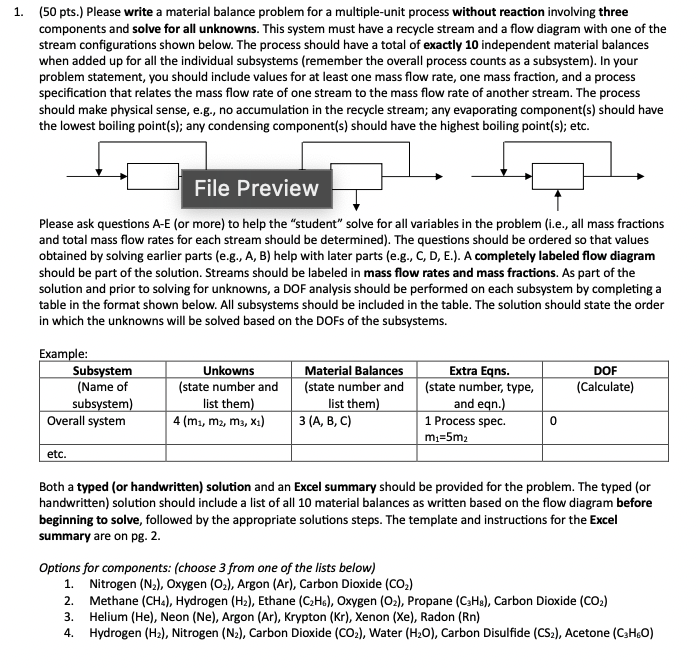
components and solve for all unknowns. This system must have a recycle stream and a flow diagram with one of the
stream configurations shown below. The process should have a total of exactly independent material balances
when added up for all the individual subsystems remember the overall process counts as a subsystem In your
problem statement, you should include values for at least one mass flow rate, one mass fraction, and a process
specification that relates the mass flow rate of one stream to the mass flow rate of another stream. The process
should make physical sense, eg no accumulation in the recycle stream; any evaporating components should have
the lowest boiling points; any condensing components should have the highest boiling points; etc.
Please ask questions AE or more to help the "student" solve for all variables in the problem ie all mass fractions
and total mass flow rates for each stream should be determined The questions should be ordered so that values
obtained by solving earlier parts eg A B help with later parts eg C D E A completely labeled flow diagram
should be part of the solution. Streams should be labeled in mass flow rates and mass fractions. As part of the
solution and prior to solving for unknowns, a DOF analysis should be performed on each subsystem by completing a
table in the format shown below. All subsystems should be included in the table. The solution should state the order
in which the unknowns will be solved based on the DOFs of the subsystems.
Example:
Both a typed or handwritten solution and an Excel summary should be provided for the problem. The typed or
handwritten solution should include a list of all material balances as written based on the flow diagram before
beginning to solve, followed by the appropriate solutions steps. The template and instructions for the Excel
summary are on pg
Options for components: choose from one of the lists below
Nitrogen Oxygen Argon Ar Carbon Dioxide
Methane Hydrogen Ethane Oxygen Propane Carbon Dioxide
Helium He Neon Ne Argon Ar Krypton Kr Xenon Xe Radon Rn
Hydrogen Nitrogen Carbon Dioxide Water Carbon Disulfide
Step by Step Solution
There are 3 Steps involved in it
1 Expert Approved Answer
Step: 1 Unlock

Question Has Been Solved by an Expert!
Get step-by-step solutions from verified subject matter experts
Step: 2 Unlock
Step: 3 Unlock
 Study Help