







Question: 5, (10 points) In this problem we are going to construct one regular language over alphabet 2 from another regular language over the alphabet L.
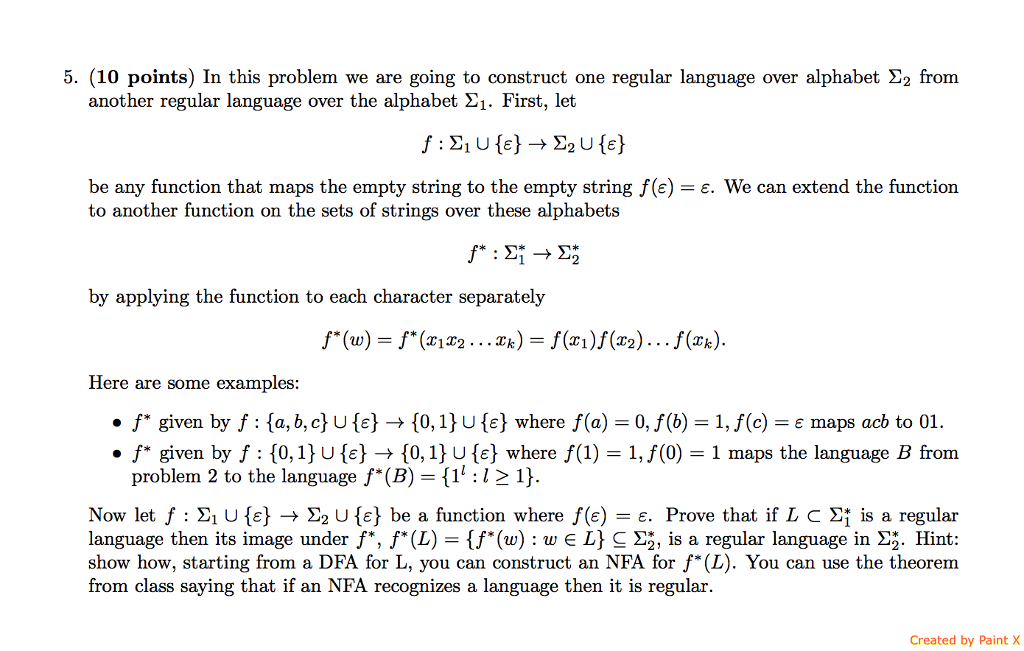
5, (10 points) In this problem we are going to construct one regular language over alphabet 2 from another regular language over the alphabet L. First, let be any function that maps the empty string to the empty string f(e) to another function on the sets of strings over these alphabets . We can extend the function by applying the function to each character separately Here are some examples: . f* given by f : {a, b, c} U {} {0,1} U {e) where f(a) 0,f(b)-1, f(c)-e maps ac to 01. . f* given by f : {0,1} U {e) {0,1} U {} where f(1) = 1,f(0) = 1 maps the language from problem 2 to the language f"(B) {11 : 1-1} Now let f : 1 U {} 2U {} be a function where f() = . Prove that if L C 1 is a regular language then its image under f*, f*(L)-(f"(w): w L} 27, is a regular language in : Hint: show how, starting from a DFA for L, you can construct an NFA for f (L). You can use the theorem from class saying that if an NFA recognizes a language then it is regular. Created by Paint X
Step by Step Solution
There are 3 Steps involved in it

Get step-by-step solutions from verified subject matter experts
 Study Help