







Question: 5. (22) A monopoly firm faces two consumers; one whose demand is Q1=8P. The other's demand is Q2= 162P. The firm has zero costs C(Q)=0.
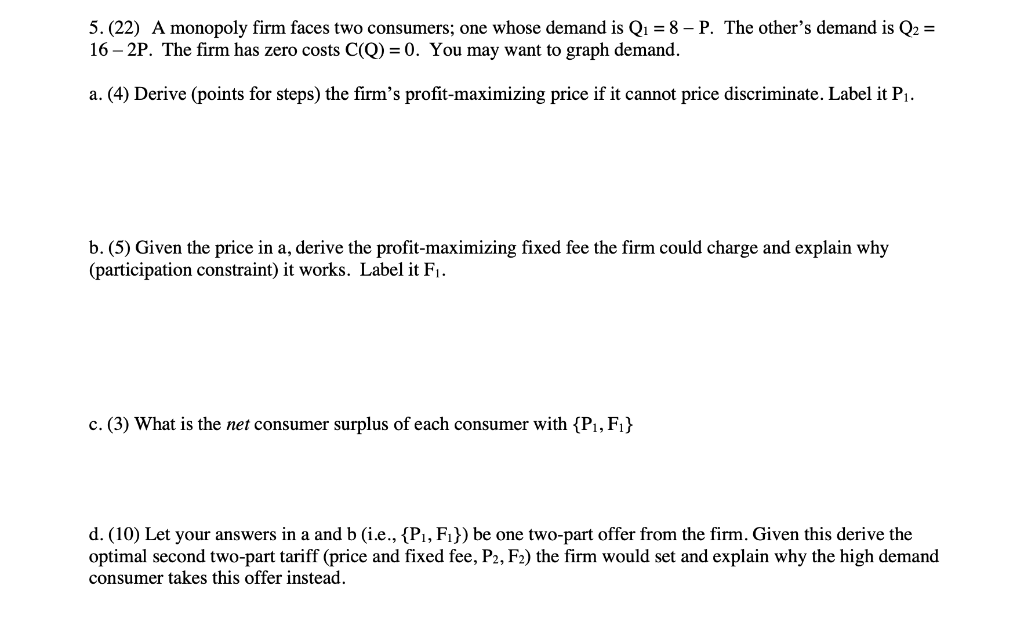
5. (22) A monopoly firm faces two consumers; one whose demand is Q1=8P. The other's demand is Q2= 162P. The firm has zero costs C(Q)=0. You may want to graph demand. a. (4) Derive (points for steps) the firm's profit-maximizing price if it cannot price discriminate. Label it P1. b. (5) Given the price in a, derive the profit-maximizing fixed fee the firm could charge and explain why (participation constraint) it works. Label it F1. c. (3) What is the net consumer surplus of each consumer with {P1,F1} d. (10) Let your answers in a and b (i.e., {P1,F1} ) be one two-part offer from the firm. Given this derive the optimal second two-part tariff (price and fixed fee, P2,F2 ) the firm would set and explain why the high demand consumer takes this offer instead
Step by Step Solution
There are 3 Steps involved in it

Get step-by-step solutions from verified subject matter experts
 Study Help