



Question: 5 . 3 Soap Makers International Contributed by Mary M . Oxner PhD , CA , CFA Associate Professor, Gerald Schwartz School of Business, St
Soap Makers International
Contributed by
Mary M Oxner PhD CA CFA
Associate Professor, Gerald Schwartz School of Business, St Francis Xavier University, Antigonish
Several years ago, Ingrid Krause wanted some international experience and applied for a transfer to her company's soap division, which is located south of Warsaw, Poland. The soap division manufactures hand soap for use in a large number of settings, from hospitals to luxury hotels. Ingrid was awarded the transfer to the soap division and was assigned to the accounting department. She is responsible for overseeing the costing and profitability analysis of the various soaps and soapmaking processes. During her tenure in the soap division, there were numerous changes in the number of soaps manufactured and the processes to make the different soaps. Consequently, Ingrid's position required her to consider changes in the accounting system to reflect the changes in the soap division's business.
For several decades, the company's soapmaking process required a large labour force that manufactured and packaged the soap mostly by hand. Local economic changes meant that the labour force that the factory required was not as available as it had been in the past. As a result, the division was experiencing significant employee turnover, which often resulted in increased expenses related to training new hires, slower processing time, and more soap being rejected during inspections because of quality concerns. To address the issues related to the lack of labour availability, the division's management decided three years ago that automation was the way to go Consequently, over the last three years, the soapmaking processes have changed with the implementation of automation.
The automation of the soapmaking process has allowed for a much larger variety of soap and packaging, a reduced direct labour force and direct labour costs, and a higher level of traceability of costs to the various soaps because of technological improvements. Soaps made for industrial applications require different ingredients, less time in processing, less time in finishing, and less time in and cheaper packaging than do soaps made for the hotel industry. The costs of materials and packaging are directly traceable to the various types of soaps through new software that uses bar codes and counters to trace direct material costs to the various soaps directly.
Ingrid feels that the current costing system should be revisited. The cost driver for allocation of the overhead costs such as supervisory salaries and plant utilities has always been direct labour cost. However, given the decline in the use of labour due to automation, Ingrid is questioning its suitability as a basis of allocation. Ingrid would like to explore activitybased costing to allocate overhead costs.
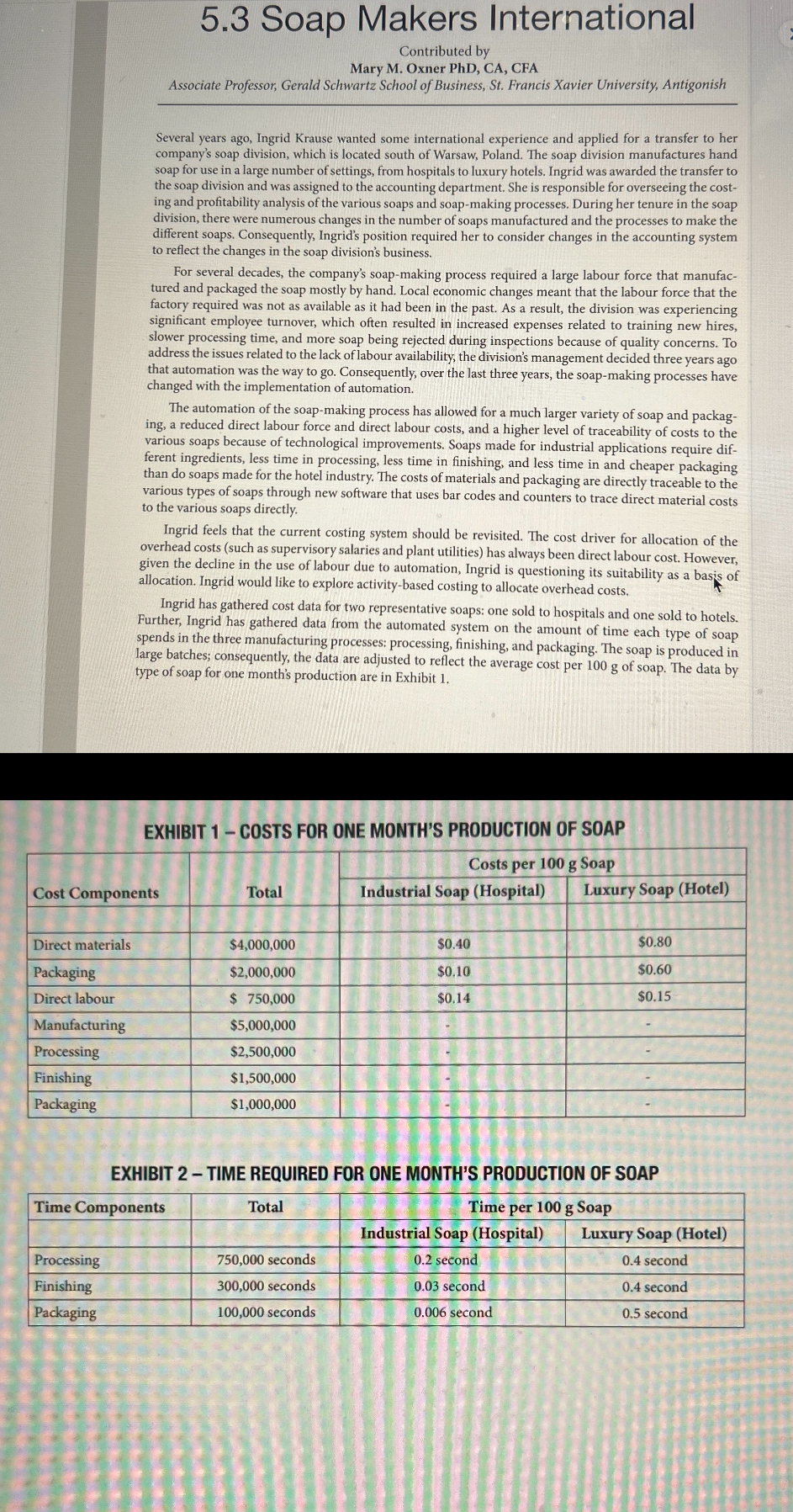
Ingrid has gathered cost data for two representative soaps: one sold to hospitals and one sold to hotels. Further, Ingrid has gathered data from the automated system on the amount of time each type of soap spends in the three manufacturing processes: processing, finishing, and packaging. The soap is produced in large batches; consequently, the data are adjusted to reflect the average cost per g of soap. The data by type of soap for one month's production are in Exhibit
EXHIBIT COSTS FOR ONE MONTH'S PRODUCTION OF SOAP
tableCost Components,Total,Costs per g SoapIndustrial Soap HospitalLuxury Soap HotelDirect materials,$Packaging$$$ Prepare a response to this case. Your response should be formatted using the situation, analysis, and a conclusion
Step by Step Solution
There are 3 Steps involved in it
1 Expert Approved Answer
Step: 1 Unlock

Question Has Been Solved by an Expert!
Get step-by-step solutions from verified subject matter experts
Step: 2 Unlock
Step: 3 Unlock