


Question: 5 . 5. In biology / ecology, a typical application of the Bernoulli differential equation is a common model of population growth, in which the

5
5 . 5. In biology / ecology, a typical
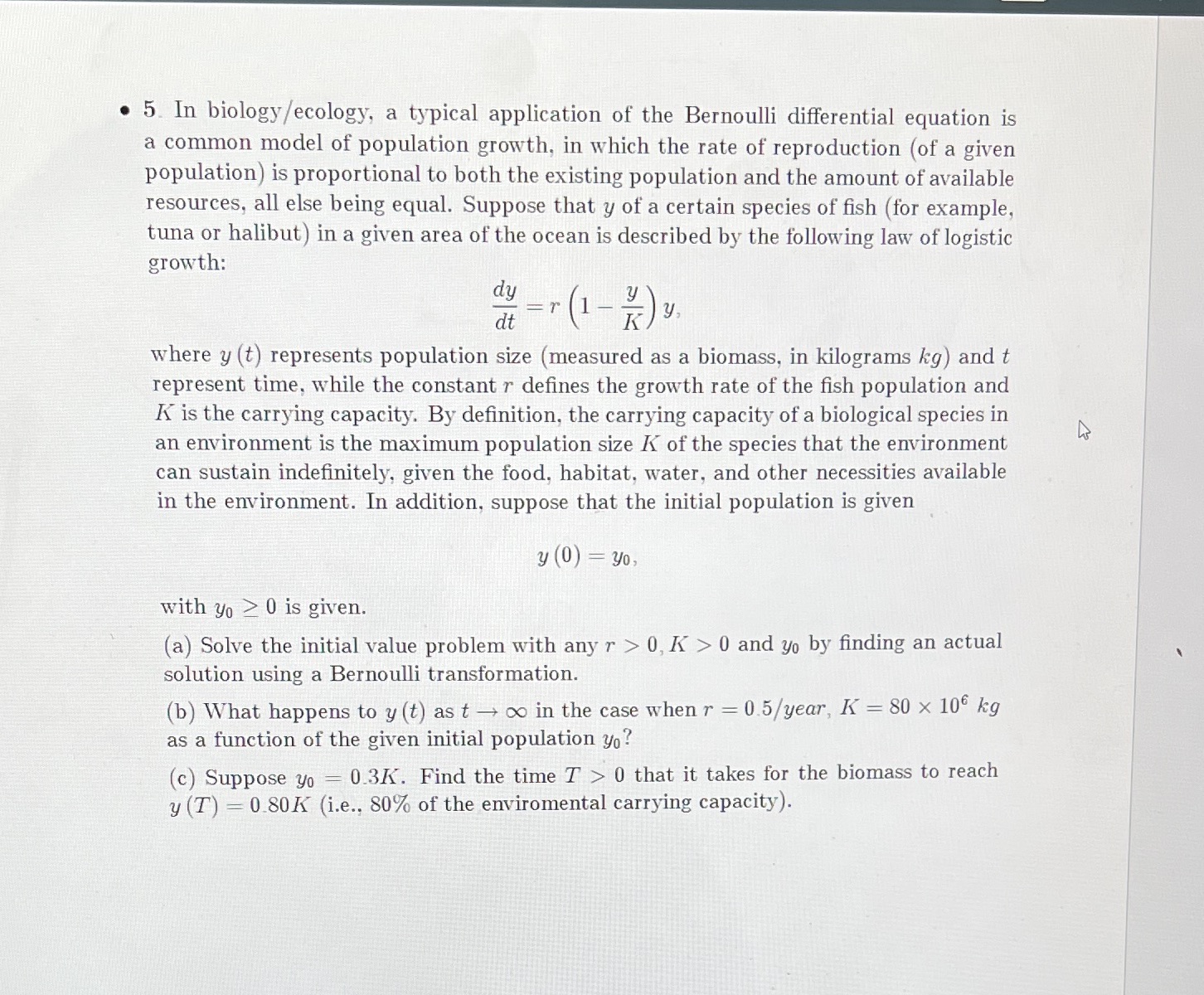
. 5. In biology / ecology, a typical application of the Bernoulli differential equation is a common model of population growth, in which the rate of reproduction (of a given population) is proportional to both the existing population and the amount of available resources, all else being equal. Suppose that y of a certain species of fish (for example, tuna or halibut) in a given area of the ocean is described by the following law of logistic growth: dy dt ( 1 - 7 ) y where y (t) represents population size (measured as a biomass, in kilograms kg) and t represent time, while the constant r defines the growth rate of the fish population and K is the carrying capacity. By definition, the carrying capacity of a biological species in an environment is the maximum population size K of the species that the environment can sustain indefinitely, given the food, habitat, water, and other necessities available in the environment. In addition, suppose that the initial population is given y (0) = yo , with yo _ 0 is given. (a) Solve the initial value problem with any r > 0, K > 0 and yo by finding an actual solution using a Bernoulli transformation. (b) What happens to y (t) as t - co in the case when r = 0.5/year, K = 80 x 10 kg as a function of the given initial population yo? (c) Suppose yo = 0.3/. Find the time 7 > 0 that it takes for the biomass to reach y (T) = 0.80K (i.e., 80% of the enviromental carrying capacity)

Step by Step Solution

There are 3 Steps involved in it

1 Expert Approved Answer
Step: 1 Unlock blur-text-image

Question Has Been Solved by an Expert!

Get step-by-step solutions from verified subject matter experts

Step: 2 Unlock
Step: 3 Unlock

Students Have Also Explored These Related Mathematics Questions!