







Question: 5). a). C. Two point charges are lying on the y-axis as in the figure: q = -4.10 C and q2 = +4.10 C.
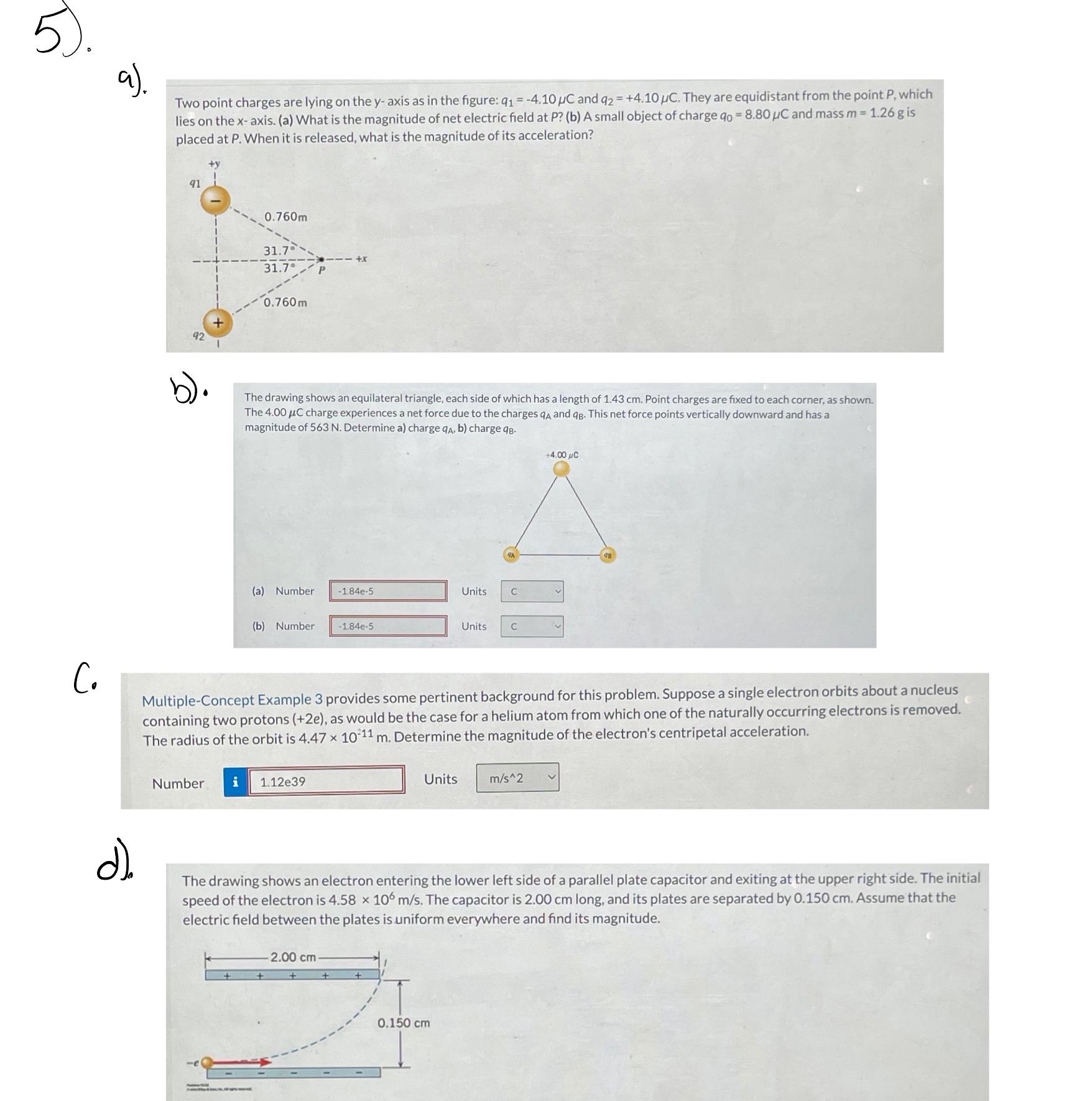
5). a). C. Two point charges are lying on the y-axis as in the figure: q = -4.10 C and q2 = +4.10 C. They are equidistant from the point P, which lies on the x-axis. (a) What is the magnitude of net electric field at P? (b) A small object of charge qo = 8.80 C and mass m = 1.26 g is placed at P. When it is released, what is the magnitude of its acceleration? 91 92 +y 0.760m 31.7 31.7 0.760m b). The drawing shows an equilateral triangle, each side of which has a length of 1.43 cm. Point charges are fixed to each corner, as shown. The 4.00 C charge experiences a net force due to the charges q and qg. This net force points vertically downward and has a magnitude of 563 N. Determine a) charge q, b) charge qB. A (a) Number -1849-5 Units C (b) Number -184e-5 Units C +4.00 Multiple-Concept Example 3 provides some pertinent background for this problem. Suppose a single electron orbits about a nucleus containing two protons (+2e), as would be the case for a helium atom from which one of the naturally occurring electrons is removed. The radius of the orbit is 4.47 x 10⁻¹¹ m. Determine the magnitude of the electron's centripetal acceleration. Number i 1.12e39 Units m/s^2 d The drawing shows an electron entering the lower left side of a parallel plate capacitor and exiting at the upper right side. The initial speed of the electron is 4.58 x 10⁶ m/s. The capacitor is 2.00 cm long, and its plates are separated by 0.150 cm. Assume that the electric field between the plates is uniform everywhere and find its magnitude. 2.00 cm + + + 0.150 cm
Step by Step Solution
There are 3 Steps involved in it

Get step-by-step solutions from verified subject matter experts
 Study Help